 |
|
||||||||||||
|
Institute of Philology of
the Siberian Branch of Russian Academy of Sciences |
|
||||||||||||
|
|||||||||||||


 | |
| Sibirskii Filologicheskii Zhurnal (Siberian Journal of Philology) | |
| |
|
Article
Authors: Dina B. Nikulicheva Institute of Linguistics of the Russian Academy of Sciences, Moscow, Russian Federation In the section Linguistics
Abstract: This article analyzes the quantitative and qualitative shifts in acquired multilingualism within Russia over the last three centuries, focusing on its distinct evolutionary trajectory. The research examines Russian polyglots as a distinct linguistic profile, covering the period from the early 1700s to the first quarter of the 2000s. Comparing social, ethnic, gender, and age factors along-side the number and range of languages used identifies the historical dynamics of Russian multilingualism. A significant theoretical contribution is the discussion surrounding the operational definition of a “polyglot.” A proficiency benchmark of a minimum of seven languages is utilized to guarantee precise comparisons and to differentiate between typical multilingualism and genuine hyperpolyglotism. A novel classification involving four periods and their corresponding polyglot archetypes is proposed: polyglot aristocrats, polyglot scholars, polyglot enthusiasts of the Soviet era, and online polyglots. Alexander Griboedov, Alexander Pushkin, and Leo Tolstoy represent the first category. The second comprises scholars such as Alexander Vostokov, Vasily Bartold, Ivan Boduen de Courtenay, and Alexander Kazem-Bek. Soviet polyglots, including Anatoly Starostin, Sergey Khalipov, Irina Shubina, and Willi Melnikov, represent the third group. Notable 21st-century polyglots are Dmitry Petrov, Alan Bigulov, Yan Aleshkevich, and Bela Devyatkina. The research explores the evolution from aristocratic education as a catalyst to the multi-ethnic scholarly tradition and the Soviet “enthusiast” movement. For the 21st century, the study highlights personalized lingua-didactic strategies, reliance on AI technologies, and the revival of early multilingual upbringing. Ultimately, the work demonstrates the polyglot personality adaptation to the shifting sociocultural and technological landscapes of Russia. Keywords: linguistic personality, acquired multilingualism, polyglottery, historical dynamics, lingua-didactic practice Bibliography: Bigulov A. K. Eksperiment po primeneniyu metodiki giperintensiva dlya vkhozhdeniya v razgovornuyu praktiku nemetskogo yazyka tol’ko vo vzaimodeystvii s II-t’yutorami [Experiment on the application of the hyperintensive method for entering into conversational practice of the German language only in interaction with AI tutors]. Filologicheskiye nauki v MGIMO [MGIMO Journal of Language Research and Teaching]. 2025, no. 11 (3), pp. 24–54. DOI 10.24833/2410-2423-2025-3-44-24-54 Erard M. Babel no more: the search for the world’s most extraordinary language learners. New York, Free Press, 2012, 306 p. Herzen A. I. Ot izdatelya [From the editor]. In Zapiski knyagini E. R. Dashkovoy, pisannye eyu samoy [Memoirs of Princess Dachkaw written by herself]. London, Free Russian Printing House of A. I. Herzen and N. P. Ogarev, 1859, pp. V–XVI. Griboedov A. S. Gore ot uma [Woe from wit]. Leningrad, Det. lit., 1971, 175 p. Karaulov Yu. N. Russkiy yazyk i yazykovaya lichnost’ [Russian language and linguistic personality]. Moscow, Nauka, 1987, 264 p. Kazakov G. Polyglottery as a science. In International Conference on multilingual proficiency: Language, Polyglossia and Polyglottery. Finke W., Ashley L. (Eds.). New York, The American Society of Geolinguistics, 2016, pp. 133–137. Nikulicheva D. B. Kak nayti svoy put’ k inostrannym yazykam: lingvisticheskie i psшkhologicheskie strategii poliglotov [How to find your way to foreign languages. Linguistic and psychologic strategies of polyglots]. Moscow, Flinta–Nauka, 2009, 304 p. Nikulicheva D. B. Govorim, chitaem, pishem: lingvisticheskie i psikhologicheskie strategii poliglotov [Speaking, reding, writing: Linguistic and psychologic strategies of polyglots]. Moscow, Flinta–Nauka, 2013, 288 p. Nikulicheva D. B. Primenenie psikholingvisticheskikh strategiy poliglotov v praktike izucheniya inostrannykh yazykov [Application of psycholinguistic strategies of polyglots for language learning]. Journal of Psycholinguistics. 2013a, no. 2 (18), pp. 90–97. Spivak D. L. Kak stat’ poliglotom [How to become a polyglot]. Leningrad, Lenizdat, 1989, 144 p. Pellegrini C. What polyglots can teach us. Language maintenance in multilinguals from a dynamic model of multilingualism perspective. University of Innsbruck, 2020, 372 p. Todeva E., Cenoz, J. Multilingualism: Emic and etic perspectives. In The multiple realities of multilingualism: Personal narratives and researchers’ perspectives. Todeva E., Cenoz J. (Eds.). New York, Mouton de Gruyter. 2009, pp. 1–32. (Trends in applied linguistics; iss. 3) Watt R. Pis’ma iz Rossii (Napisano v sentyabre i oktyabre 1866 g.) [“Letters from Russia (Written in September and October 1866)]. E. Krasnova (Ed.). St. Petersburg, Simpozium, 2026, 122 p. |


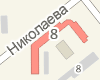 |
Institute of Philology Nikolaeva st., 8, Novosibirsk, 630090, Russian Federation +7-383-330-15-18, ifl@philology.nsc.ru |
© Institute of Philology |