 |
|
||||||||||||
|
Institute of Philology of
the Siberian Branch of Russian Academy of Sciences |
|
||||||||||||
|
|||||||||||||


 | |
| Sibirskii Filologicheskii Zhurnal (Siberian Journal of Philology) | |
| |
|
Article
Authors: Marina V. Kutsaeva Institute of Linguistics of the Russian Academy of Sciences, Moscow, Russian Federation In the section Linguistics
Abstract: This paper presents the findings from sociolinguistic surveys conducted in 2024 among the long-standing Mari diaspora communities in Bashkortostan and Tatarstan. The surveys focused on the phenomenon of “new speakers.” Of a sample of 287 respondents, 18 were identified as new speakers. Their linguistic biographies differ significantly from those of traditional speakers, primarily due to their childhood residence in dispersed settlement areas following Soviet and post-Soviet migrations. Upon returning to their ancestral homelands, these individuals had to reintegrate into the Mari-speaking community, a process involving unique motivations for language acquisition and a profound drive for identity completion. This study explores how Mari speech practices are shaped by two core linguistic ideologies. The ideology of authenticity links the ethnic language to particular rural areas (Mari villages), whereas the ideology of anonymity portrays Russian as the standard language for urban and public spaces. According to our previous research findings, the Mari language within traditional Mari communities is regarded as an integral part of the Mari people’s ethnic identity and sense of belonging. This perspective is consistent with the essentialist viewpoints commonly observed in minority language communities worldwide. Consequently, new speakers raised in Russian-dominant environments often encounter substantial social and psychological barriers. Upon returning to rural areas, they must navigate these essentialist views in order to reconstruct their ethnic identity and gain acceptance within traditional speaker communities. The article concludes that for these “new speakers,” language is not merely a tool for communication, but also a contested site of belonging. Keywords: Mari language, new speakers, traditional speakers, speech practices, linguistic ideologies, ethnic language, ethnic identity, Mari diasporas Bibliography: Farfán J. A. F., Olko J. Types of Communities and Speakers in Language Revitalization. In Revitalizing Endangered Languages: A Practical Guide. J. Olko, J. Sal-labank J. (Eds.). Cambridge Uni. Press, 2021, pp. 85–103. Grinevald C., Bert M. Speakers and communities. In The Cambridge Handbook of Endangered Languages. P. K. Austin, J. Sallabank (Eds.). Cambridge Uni. Press, 2011, pp. 45–65. Jaffe A. Defining the new speaker: Theoretical perspectives and learner trajectories. International Journal of the Sociology of Language. 2015, no. 231, pp. 21–44. Kutsaeva M. V. Novye nositeli mariyskogo kak faktor vital’nosti etnicheskogo yazyka v diaspore [New speakers of Mari as a factor in diaspora language vitality]. Rodnoy Yazyk [Mother Tongue]. 2021, no. 2, pp. 5–34. Kutsaeva M. V. Mariyskiy v Moskve: k voprosu o sokhrannosti etnicheskogo yazyka v usloviyakh vnutrenney diaspory [The Mari language in Moscow: The problem of ethnic language preservation in the conditions of an internal diaspora]. Finno-Ugric Studies. 2022, no. 63, pp. 30–44. Ó Murchadha N. P., Hornsby M., Smith-Christmas C., Moriarty M. New Speakers, Familiar Concepts? In New Speakers of Minority Languages. C. Smith-Christmas, N. P. Ó Murchadha, M. Hornsby, M. Moriarty (Eds.). Palgrave Macmillan, London, 2018, pp. 1–22. O’Rourke B. New speakers of minority languages. In The Routledge Handbook of Language Revitalization. L. Hinton, L. Huss, G. Roche (Eds.). Routledge, Taylor & Francis Group, New York and London, 2018, pp. 265–273. O’Rourke B., Pujolar J., Ramallo F. New speakers of minority languages: The challenging opportunity. In International Journal of the Sociology of Language. Special Issue. 2015, no. 231, pp. 1–20. O’Rourke B., Ramallo F. Identities and New Speakers of Minority Languages: A Focus on Galician. In New Speakers of Minority Languages. C. Smith-Christmas, N. P. Ó Murchadha, M. Hornsby, M. Moriarty (Eds.). Palgrave Macmillan, London, 2018, pp. 91–109. Sallabank J. Attitudes to endangered languages: Identities and Policies. Cambridge University Press, 2013, 271 p. Sepeev G. A. Istoriya rasseleniya mariytsev [History of Maris’ settlement]. Yoshkar-Ola, 2006, 200 p. Smith-Christmas C. Land, Language and Migration: World War II Evacuees as New Speakers of Scottish Gaelic. In New Speakers of Minority Languages. C. Smith-Christmas, N. P. Ó Murchadha, M. Hornsby, M. Moriarty. Palgrave Macmillan (Eds.). London, 2018, pp. 131–150. Woolard K. A. Language and identity choice in Catalonia: The interplay of contrasting ideologies of linguistic authority. In Lengua, nación e identidad. La regulación del plurilingüismo en España y América Latina. K. Süselbeck, U. Mühlschlegel, P. Masson (Eds.). Madrid-Frankfurt am Main, Iberoamericana-Vervuert Verlag, 2008, pp. 303–324. |


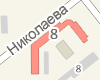 |
Institute of Philology Nikolaeva st., 8, Novosibirsk, 630090, Russian Federation +7-383-330-15-18, ifl@philology.nsc.ru |
© Institute of Philology |