 |
|
||||||||||||
|
Institute of Philology of
the Siberian Branch of Russian Academy of Sciences |
|
||||||||||||
|
|||||||||||||


 | |
| Sibirskii Filologicheskii Zhurnal (Siberian Journal of Philology) | |
| |
|
Article
Authors: Andrey E. Agratin Russian State University for the Humanities, Moscow, Russian Federation; Gorky Institute of World Literature of the Russian Academy of Science, Moscow, Russian Federation In the section Study of literature
Abstract: Scholarly research is frequently likened to an investigation, a parallel deeply rooted in lexicography. However, this paper posits that research in the humanities is not merely a cognitive activity but a specific mode of discourse. Given that the humanities rely on natural rather than formal language, the researcher must often navigate “non-scientific” communicative parameters, such as reader engagement. Consequently, the author argues that it is more productive to compare theoretical research not with criminological procedures, but with the narrative structure of a detective story. Gérard Genette’s seminal work, “The Boundaries of Narrative” (“Frontières du récit”), is analyzed using analytical tools typically reserved for criminal prose (drawing on the frameworks of N. D. Tamarchenko, N. N. Kirilenko, and O. V. Fedunina). Genette’s text reveals hallmark features of detective storytelling: the enigma–resolution dichotomy (problem formulation and solution), the verification of versions (review and critique of competing view-points), and the use of evidence (literary phenomena acting as “symptoms” of universal narrative properties). Furthermore, the study identifies the presence of the “Great Detective” figure, as the theorist implicitly asserts a sense of intellectual exceptionalism by debunking stereotypes to uncover the truth. While a “detective” mode might seem more naturally suited to historical-literary research (the search for empirical “clues”), this study demonstrates that it functions as an external rhetorical model. By applying this lens to a purely theoretical text, the author highlights the “indifference” of the detective mode to the specific subject matter, proving its status as a universal communicative strategy in scholarly discourse. Keywords: science, communication, theoretical-literary study, literary theory, investigation, detective prose, classic detective, literature of investigation Bibliography: Austin J. Performativnye vyskazyvaniya [Performative utterances]. In Austin J. Tri sposoba prolit’ chernila: Filosofskie raboty [Three ways to spill ink: philosophical works]. St. Petersburg, Aleteiya, SPbSU Publ., 2006, pp. 262–281. Balatskiy E. V. Smena nauchno-poiskovoy paradigmy: rassledovaniya protiv issledovaniy [Changing the scientific research paradigm: investigations vs. research]. Nauka. Innovatsii. Obrazovanie. 2008, vol. 3, iss. 1, pp. 96–106. Barthes R. Vvedenie v strukturnyy analiz povestvovatel’nykh tekstov [Introduction to the structural analysis of narrative texts]. In Zarubezhnaya estetika i teoriya literatury 19–20 vv. Traktaty, stat’i, esse [Foreign aesthetics and theory of literature of the 19th–20th centuries: treatises, articles, essays]. Moscow, MSU Publ., pp. 387–422. Compagnon A. Demon teorii [The demon of theory]. Moscow, Izd. im. Sabashnikovykh, 2001, 336 p. Eco U. Rol’ chitatelya. Issledovaniya po semiotike teksta [The role of the reader: explorations in the semiotics of texts]. St. Petersburg, Simpozium, 2005, 502 p. Fedunina O. V. Kriminal’nyy bestiariy: zver’ – tekst – zhanr: monografiya [Criminal bestiary: beast – text – genre: a monograph]. Tula, Akvarius, 2023, 148 p. Fukson L. Yu. Uroki detektiva [Lessons from detective fiction]. In Rok-pedagogika: teoriya i praktika: k 60-letiyu S. P. Lavlinskogo: sbornik nenauchnykh sochineniy [Rock pedagogy: theory and practice: on the 60th anniversary of S. P. Lavlinsky: A collection of non-scientific works]. Moscow, Editus, 2020, pp. 108–114. Genette G. Granitsy povestvovatel’nosti [The boundaries of narrative] In Genette G. Figury: V 2 t. [Figures: In 2 vols.]. Moscow, Izd. im. Sabashnikovykh, 1998a, vol. 1, pp. 283–299. Genette G. Povestvovatel’nyy diskurs [Narrative discourse]. In Genette G. Figury: V 2 t. [Figures: In 2 vols.]. Moscow, Izd. im. Sabashnikovykh, 1998b, vol. 2, pp. 60–281. Kirilenko N. N. Klassicheskiy detektiv kak zhanr kriminal’noy literatury: invariant i genesis [The classical detective story as a genre of criminal fiction: invariant and genesis]. Moscow, Ekaterinburg, Kabinetnyy uchenyy, 2020, 245 p. Komarov I. M. Metod nauchnogo poznaniya i metody prakticheskoy deyatel’nosti po rassledovaniyu prestupleniy (Chast’ I) [The method of scientific cognition and methods of practical activity in crime investigation (Part I)]. Yurist-Pravoved. 2022, no. 2 (101), pp. 20–23. Lotman Yu. M. Logika vzryva [The logic of explosion]. In Lotman Yu. M. Semiosfera [Semiosphere]. St. Petersburg, Iskusstvo-SPb, 2000, pp. 101–108. Moiseev P. A. Poetika detektiva [The poetics of detective fiction]. Moscow, HSE Publishing House, 2017, 240 p. Slovar’ russkogo yazyka: V 4 t. [Dictionary of the Russian language: In 4 vols.]. Moscow, Russkiy Yazyk, Poligrafresursy, 1999b, vol. 3: P–R, 750 p.; 1999a, vol. 1: A–Ya, 701 p. Staf I. Chitatel’ vnutri teksta, ili Lukavaya semiotika (Umberto Eko. Rol’ chitatelya: Issledovaniya po semiotike teksta) [The reader within the text, or the devious semiotics (Umberto Eco. The role of the reader: studies in the semiotics of text)]. Otechestvennye zapiski. 2007, no. 5. URL: https://strana-oz.ru/2007/5/chitatel-vnutri-teksta-ili-lukavaya-semiotika-umberto-eko-rol-chitatelya-issledovaniya-po-semiotike-teksta (accessed 31.01.2025). Tamarchenko N. D. Detektivnaya proza [Detective prose]. In Poetika: slovar’ aktual’nykh terminov i ponyatiy [Poetics: a dictionary of current terms and concepts]. Moscow, Izd. Kulaginoy, Intrada, 2008, pp. 55–56. Tushin’ska Yu. Detektiv i teoriya interpretatsii [Detective fiction and the theory of interpretation]. In Problemy poetiki, genezisa i evolyutsii kriminal’noy literatury: Sb. nauch. st. [Problems of poetics, genesis, and evolution of crime literature: A coll. of sci. arts.]. Moscow, Izd. Ippolitova, 2022, pp. 57–66. Tyupa V. I. Narrativnaya intriga “Doktora Zhivago” [The narrative intrigue of “Doctor Zhivago”]. The New Philological Bulletin. 2013, no. 2 (25), pp. 72–91. Tyupa V. I. Teoriya literatury: Uchebnik [Theory of literature: A textbook]. Moscow, RSUH, 2024, 254 p. Vol’skiy N. N. Legkoe chtenie: raboty po teorii i istorii detektivnogo zhanra: monografiya [Light reading: works on the theory and history of the detective genre: a monograph]. Novosibirsk, NSPU, 2006, 278 p. |


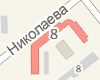 |
Institute of Philology Nikolaeva st., 8, Novosibirsk, 630090, Russian Federation +7-383-330-15-18, ifl@philology.nsc.ru |
© Institute of Philology |