 |
|
||||||||||||
|
Institute of Philology of
the Siberian Branch of Russian Academy of Sciences |
|
||||||||||||
|
|||||||||||||


 | |
| Sibirskii Filologicheskii Zhurnal (Siberian Journal of Philology) | |
| |
|
Article
Authors: Lyubov N. Arbachakova Institute of Philology of the Siberian Branch of the Russian Academy of Sciences, Novosibirsk, Russian Federation In the section Study of folklore
Abstract: This paper explores the specific features and functions of ritual actions and performative remarks made by Shor storytellers (kaichi) from various storytelling schools during the performance of heroic epics. A comprehensive analysis is conducted on the exemplary performances delivered by practitioners of the two dominant Shor traditions: the Kondom school, exemplified by V. I. Tokmashov and S. S. Torbokov, and the Mrass school, represented by A. P. Napazakov, V. E. Tannagashev, A. V. Ryzhin, and D. K. Turushpanov. Two primary types of metacommunicative remarks are identified” (1) the performance is initiated with invocations directed towards to the musical instrument and the audience prior to the performance itself, marking the storyteller’s “entry” into the epic world; and (2) the performance is followed by remarks signaling the storyteller’s return from the epic world to the reality of the audience, including concluding addresses. The internal functions of the storyteller while dwelling within the epic world are addressed by the author in a separate study. As the central figure of the narrative act, the kaichi assumes a dual responsibility, both at the beginning and the end of the performance, for the ritual accuracy of the transmission. This accountability is held before the epic hero, the spirits of the kai (kai eezi), and the physical audience. The findings indicate that only through this ritual-magical framework can the storyteller safely cross into the “otherworld” to follow the path of the protagonist, thereby maintaining the ontological balance between the two realms. Keywords: storytelling schools, heroic tales, kaichi, performance, epic world, listeners Bibliography: Аlеkseev N. А. Shamanizm tyurkoyazychnykh narodov Sibiri [Shamanism of the Turkic-speaking peoples of Siberia]. Novosibirsk, Nauka, 1984, 232 p. Altayskiye geroicheskiye skazaniya: Ochi-Bala. Kan-Altyn [Altai heroic tales: Ochi-Bala. Kan-Altyn]. Novosibirsk, Nauka, 1997, 668 p. (Pamyatniki fol’klora narodov Sibiri i Dal’nego Vostoka [Monuments of folklore of the peoples of Siberia and Far East]. Vol. 15) Arbachakova L. N. Rolevyye funktsii kaychi v shorskikh geroicheskikh skazaniyakh [The role functions of the Kaichi in Shor heroic epics]. Humanitarian sciences in Siberia. Novosibirsk, 2003, no. 3, pp. 92–95. Chudoyakov A. I. Etudy shorskogo eposa [Études of the Shor Epic]. Kemerovo, Kemerovo book publishing house, 1995, 221 p. Folklor Shortsev [Folklore of the Shor people]. L. N. Arbachakova (Comp.). Novosibirsk, Nauka, 2010, 608 p. Pamyatniki fol’klora narodov Sibiri i Dal’nego Vostoka [Monuments of folklore of the peoples of Siberia and Far East]. Vol. 29) Funk D. A. Miry shamanov i skaziteley: kompleksnoye issledovaniye teleutskikh i shorskikh materialov [The worlds of shamans and storytellers: a comprehensive study of Teleut and Shor materials]. Moscow, Nauka, 2005, 401 p. Lord A. B. Skazitel’ [The singer of tales]. Yu. A. Kleiner, A. G. Levinton (Preparation, transl. from English, and comments). 2nd ed. corrected and enlarged. St. Petersburg, Publishing House of the European State University, 2018, 552 p. Maynogasheva V. E. Nekotoryye elementy kompozitsii khakasskogo eposa [Some elements of the composition of the Khakass epic]. In Problemy khakasskogo fol’klora [Problems of Khakass folklore]. Abakan, 1982, pp. 42–70. Putilov B. N. Epicheskoye skazitel’stvo: tipologiya i etnicheskaya spetsifika [Epic storytelling: typology and ethnic specifics]. Moscow, Vost. lit., 1997, 295 p. Radloff W. Obraztsy narodnoy literatury tyurkskikh plemen, zhivushchikh v Yuzhnoy Sibiri i Dzhungarskoy stepi [Examples of the folk literature of the Turkic tribes of Southern Siberia]. St. Petersburg, Tip. Imp. akad. nauk, 1866, pt. 2, 712 p. Reichl’ Karl. Tyurkskiy epos: traditsii, formy, poeticheskaya struktura [The Turkic epic: traditions, forms, and poetic structure]. V. Treister (Transl. from English), D. A. Funk (Ed.). Moscow, Vost. lit., 2008, 383 p. (Issledovaniya po fol’kloru i mifologii Vostoka [Research on folklore and mythology of the East]) Sadalova T. M. Magicheskiye funktsii skazitel’stva altayskogo naroda v sopostavlenii s tsentral’no-aziatskimi traditsiyami [Magical functions of storytelling of the Altai people in comparison with Central Asian traditions]. Uchen. zap. Alt. gos. akademii kul’tury i iskusstv. 2018, no. 2 (16), pp. 246–254. Shinzhin I. B. Altayskiye mify i ikh ispolniteli [Altai myths and their performers]. In Altay i tyurko-mongol’skiy mir [Altai and the Turkic-Mongolian world]. Gorno-Altaisk, 1995, pp. 40–48. Shorskiy folklor [Shor folklore]. N. P. Dyrenkova (Recording, trans., introduction, notes). Moscow, Leningrad, AS USSR, 1940, 448 p. Shorskie geroicheskie skazaniya. Kan-Pergen. Altyn-Syryk [Shor heroic epics. Kan-Pergen. Altyn-Syryk]. A. I. Chudoyaov (Introduction, poetic text, translation, and commentary); R. B. Nazarenko (musicological article and musical notation). Moscow, Novosibirsk, Nauka, 1998, 463 p. (Pamyatniki fol’klora narodov Sibiri i Dal’nego Vostoka [Monuments of folklore of the peoples of Siberia and Far East]. Vol. 17) Shorskiy geroicheskiy epos [Shor heroic epic]. D. A. Funk (Comp., introduction, translation, notes, and commentary). Kemerovo, Primula, 2010, vol. 1, 392 p. Skazaniya shorskogo kaychi V. Ye. Tannagasheva [Stories of the Shor kaichi V. E. Tannagashev]. E. N. Kuzmina (Ed.). Novosibirsk, NSU, 2014, 318 p. Tokmashov B. I. Kaan Oolak. Bogatyrskoye skazaniye na shorskom yazyke s perevodom na russkiy yazyk [Kaan Oolak. The heroic legend in the Shor language with translation into Russian]. Novokuznetsk, Novokuznetskiy poligrafkombinat, 2019, 149 p. Toporov V. N. Prostranstvo i text [Space and text]. In Text: semantika i struktura [Text: semantics and structure]. Moscow, 1983, pp. 227–284. |


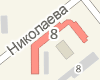 |
Institute of Philology Nikolaeva st., 8, Novosibirsk, 630090, Russian Federation +7-383-330-15-18, ifl@philology.nsc.ru |
© Institute of Philology |