 |
|
||||||||||||
|
Institute of Philology of
the Siberian Branch of Russian Academy of Sciences |
|
||||||||||||
|
|||||||||||||


 | |
| Sibirskii Filologicheskii Zhurnal (Siberian Journal of Philology) | |
| |
|
Article
Authors: Zamira K. Derbisheva, Alla G. Narozia Kyrgyz-Russian Slavic University, Bishkek, Kyrgyz Republic; Kyrgyz-Turkish Manas University, Bishkek, Kyrgyz Republic In the section Linguistics
Abstract: This article examines the differentiation and systematization of linguocognitive units that constitute the language picture of the world. The authors propose criteria for distinguishing among linguocognitive categories, such as concepts, key concepts, and symbols, based on their varying degrees of cognitive relevance. Analysis is conducted on verbalized concepts, keywords, and symbols across the Russian, Turkish, and Kyrgyz languages, highlighting their cultural-mental significance and the specific nature of linguistic perception. Concepts serve as the primary components of the language picture of the world and act as vehicles for national understanding. This is evident in the conceptual spheres of the analyzed languages, which represent universal concepts through unique content shaped by ethnonational perspectives embedded in linguistic semantics. Their meanings reveal profound knowledge related to life experiences, values, and the cognitive stereotypes of specific peoples. An examination of significant terminology across Russian, Kyrgyz, and Turkish languages indicates distinct cultural focal points, with Russian lexicons prioritizing affective states, Christian tenets, artistic principles, and recreational pursuits, Kyrgyz speakers focusing on health, kinship, and tradition, and Turkish culture highlighting communication with relatives and friends, professional ties, and patriotism. Symbolic words in each language are rooted in unique cultural histories and mentalities. Each language selects specific words to symbolize ideas based on linguocultural codes that serve as distinctive markers within a cultural area. This symbolization reflects the tendency for the human mind to project anthropomorphic and biomorphic associations onto its inner world, influenced by the natural and sociocultural environment. Keywords: language picture of the world, concept, key vocabulary, symbolic words, mentality, linguocognitive category, ethnocultural specificity Bibliography: Bryksina I. E. Lingvokul’turema kak edinitsa soderzhaniya bilingval’nogo/bikul’turnogo obucheniya inostrannym yazykam v vysshey shkole [Linguocultureme as a unit of content for bilingual/bicultural teaching of foreign languages in higher education]. Tambov University Review. Series: Humanities. 2009, no. 1 (69), pp. 102–110. Derbisheva Z. K. Artefakt “yurta” kak ob”ekt kirgizskoy i tuvinskoy lingvokul’tury [The “yurt” artifact as an object of Kyrgyz and Tuvan linguistic culture]. Sibirskii Filologicheskii Zhurnal [Siberian Journal of Philology]. 2023, no. 1, pp. 257–271. Durmaz B. Yapılandırıcı fen öğretiminde kavram karikatürlerinin öğrencilerin başarısı ve duyuşsal özelliklerine etkisi (Muğla ili merkez ilçe örneği) [The effect of concept cartoons on students' achievement and affective characteristics in constructivist science teaching (Muğla province central district example)]. Unpublished master’s thesis. Muğla, Muğla University, Graduate School of Natural and Applied Sciences, 2007. Erbek G. Hayat Ağacı Motifi I [The tree of life motif I]. Antika Dergisi. 1986, 2 (15), pp. 26–35. Ertuğrul Bütüner. Türklerde kurt sembolü [Wolf symbol in Turks]. Yeni Ufuk Dergisi [Yeni Horizon Magazine]. 2023. URL: https://www.yeniufukdergisi.com/2023/ 04/20/turklerde-kurt-sembolu/ (accessed 17.07.2024). Gabunia Z. M., Kairova R. B. Kul’turnoe kodirovanie i yazykovaya simvolika v russkom i angliyskom yazykakh [Cultural coding and linguistic symbolism in Russian and English languages]. Cuadernos de rusístisa Española. 2013, no. 9, pp. 205–213. Gak V. G. Yazykovye preobrazovaniya [Language conversions]. Moscow, 1998, 764 p. Krasnykh V. V. Kul’turnoe prostranstvo: Sistema koordinat (k voprosu o kognitivnoy nauke) [Cultural space: System of coordinates (on the issue of cognitive science)]. Respectus philologicus. 2005, no. 7 (12), pp. 10–24. Kretov A. A., Voevudskaya O. M., Merkulova I. A., Titov V. T. Edinstvo Evropy po dannym leksiki [Unity of Europe according to vocabulary data]. Voronezh, VSU, 2016, 412 p. Maroshi V. V. Troyka kak simvol istoricheskogo puti Rossii v russkoy literature 20 veka [Troika as a symbol of the historical path of Russia in Russian literature of the twentieth century]. Philology and culture. 2015, no. 2 (40), pp. 204–209. Maslova V. A. Lingvokul’turologiya: Ucheb. posobie dlya stud. vyssh. ucheb. zavedeniy [Linguistic and cultural studies: Textbook for students of higher educational institutions]. Moscow, Akademiya, 2001, 208 p. Machey Rak. K voprosu o kul’turemakh – dialektnykh, obshchepol’skikh, slavyanskikh [On the issue of cultures – dialectal, common Polish, Slavic]. In Etnolingvistika. Onomastika. Etimologiya: materialy IV mezhdunarodnoy nauchnoy konferentsii Ekaterinburg, 9–13 sentyabrya 2019 g. [Ethnolinguistics. Onomastics. Etymology: Proceedings of the IV International Scientific Conference, Yekaterinburg, September 9–13, 2019]. Ekaterinburg, Ural University, 2019, pp. 283–284. Mil’rud R. P. Yazyk kak simvol kul’tury [Language as a symbol of culture]. Language and Culture. 2013, no. 2 (22), pp. 43–60. Moskvin V. P. Russkaya metafora: Ocherk semioticheskoy teorii [Russian metaphor: Essay on semiotic theory]. 2nd ed., rev. and exp. Moscow, Lenand, 2006, 184 p. Ögel Bahaeddin. Türk Mitolojisi II [Turkish mythology II]. İstanbul, Milli Eğitim Bakanlığı Yayınları, 2001, 627 p. Radbil’ T. B. Osnovy izucheniya yazykovogo mentaliteta: Ucheb. posobie [Fundamentals of studying linguistic mentality: Textbook]. Moscow, Flinta, Nauka, 2010, 328 p. Radugin A. A. Kul’turologiya. Kurs lektsiy: Ucheb. posobie [Culturology. Course of lectures: Textbook] Moscow, Biblionika, 2005, 304 p. (Alma mater). Vedenina L. G. Teoriya mezhkul’turnoy kommunikatsii i znachenie slova [The theory of intercultural communication and the meaning of the word]. Inostrannye yazyki v shkole. 1997, no. 3, pp. 72–76. Vorob’ev V. V. Lingvokul’turologiya (teoriya i metody): Monografiya [Linguo-culturology (theory and methods): Monograph]. Moscow, RUDN, 1997, 331 p. Yung K. Arkhetip i simvol [Archetype and symbol]. Moscow, Vlados, 1991, 299 p. |


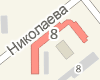 |
Institute of Philology Nikolaeva st., 8, Novosibirsk, 630090, Russian Federation +7-383-330-15-18, ifl@philology.nsc.ru |
© Institute of Philology |