 |
|
||||||||||||
|
Institute of Philology of
the Siberian Branch of Russian Academy of Sciences |
|
||||||||||||
|
|||||||||||||


 | |
| Sibirskii Filologicheskii Zhurnal (Siberian Journal of Philology) | |
| |
|
Article
Authors: Olga S. Sytnik Empress Catherine II Saint Petersburg Mining University, St. Petersburg, Russian Federation In the section Linguistics
Abstract: This paper explores the underlying causes of divergent approaches to decoding speech genres and communicative strategies between the addresser and the addressee. Emphasis is placed on the active contribution of the listener to interpreting the actions of the speaker, as manifested in reactive speech actions. The study introduces two distinct categories of speech genres: those identified by the speaker and those perceived by the listener. The analysis suggests that a speech genre may be interpreted differently depending on the participant’s perspective. The listener’s perception is governed by an evaluation of the utterance’s content based on three parameters: utility (useful vs. useless), affect (pleasant vs. unpleasant), and engagement (interesting vs. uninteresting). Furthermore, the significance of the speaker’s persona plays a critical role in the addressee’s interpretation. While ideal communication, characterized by a cooperative strategy, strives for alignment in genre interpretation, several divergent strategies of perception emerge. These include: (1) statements evoking curiosity through “pattern-breaking” (humor, jokes, or language games); (2) statements offering pleasant communication (compliments, approval) or aversive incentive talk (hints, provocations, reproaches); and (3) statements providing useful or redundant information. Ultimately, a discrepancy often arises between the addresser’s intended communicative strategy and the addressee’s actual perception, shaped by the perceived value of both the information and the speaker’s personality. Keywords: speech genre, social interaction, communicative strategy, talk exchange, addresser, addressee, speaker, listener Bibliography: Abramova E. K. Slushayushchiy kak aktivnyy uchastnik dialogicheskogo obshcheniya [The listener as an active participant in dialogical communication]. Vestnik of the Orenburg State University. 2006, no. 9 (59), pp. 174–179. Bakhtin M. M. Estetika slovesnogo tvorchestva [The aesthetics of verbal creativity]. Moscow, Iskusstvo, 1986, 445 p. Bakhtin M. M. Literaturno-kriticheskie stat’i [Literary criticism]. Moscow, Khudozh. lit., 1986, 541 p. Bakhtin M. M. Problema rechevykh zhanrov [Speech genre problem]. In Bakhtin M. M. Sobr. soch.: V 7 t. [Collected works.: in 7 vols.]. Moscow, Russkie slovari, 1996, vol. 5: Raboty 1940–1960 gg. [Works of 1940–1960], pp. 159–226. Baykulova A. N., Malashenkova E. N. Izuchenie rechevogo zhanra “pozhelanie”: obzor rabot v sovremennoy lingvistike [Study of the speech genre “wish”: a review of works in contemporary linguistics]. Speech Genres. 2023, vol. 18, iss. 1 (37), pp. 74–91. DOI 10.18500/2311-0740-2023-18-1-37-74-91 Balashova L. V., Dement’ev V. V. Russkie rechevye zhanry [Russian speech genres]. 2nd ed. Moscow, LRC Publishing House, 2022, 832 p. (Studia Philologica) Bochkova O. S. Stilisticheskie priemy manipulyatsii auditoriey (na materiale analiza vystupleniy D. Trampa i T. Mey) [Stylistic techniques of audience manipulation (based on the analysis of speeches by D. Trump and T. May)]. Sovremennye issledovaniya sotsial’nykh problem. 2018, vol. 10, no. 2–2, pp. 27–42. Chomsky N. Aspects of the theory of syntax. Cambridge, Massachusetts, MIT Press, 1965, 258 p. Dement’ev V. V. Chto dalo zhanrovedenie sovremennoy lingvistike? [What has genre studies theory given to modern linguistics?]. Speech Genres. 2020, no. 3, pp. 172–194. DOI 10.18500/2311-0740-2020-3-27-172-194 Dement’ev V. V. Kommunikativnaya genristika: rechevye zhanry kak sredstvo formalizatsii sotsial’nogo vzaimodeystviya [Communicative genristics: speech genres as a means of formalizing social interaction]. Speech Genres. 2002, no. 3, pp. 18–40. Dement’ev V. V. Osnovy teorii nepryamoy kommunikatsii [Fundamentals of the theory of indirect communication]. Cand. of art diss. Saratov, 2001, 425 p. Dement’ev V. V. Teoriya rechevykh zhanrov [Speech genre theory]. Moscow, Znak, 2010, 600 p. Denningkhaus S. Pod flagom iskrennosti: litsemerie i lest’ kak spetsificheskie yavleniya rechevogo zhanra “pritvorstvo” [Under the flag of sincerity: hypocrisy and flattery as specific phenomena of the “pretense” speech genre]. Speech Genres. 1999, no. 2, pp. 203–216. Dudkina N. V. Rechevoy zhanr “pozdravlenie” v russkoy i amerikanskoy lingvokul'turakh [The speech genre “congratulations” in Russian and American linguistic cultures]. Abstract of Cand. philol. sci. diss. Rostov on Don, 2011, 26 p. Issers O. S. Kommunikativnye strategii i taktiki russkoy rechi [Communicative Strategies and Tactics of Russian Speech]. Moscow, 2006, 284 p. Karymshakova T. G. Lingvisticheskie tekhnologii rechevogo vozdeystviya v meditsinskom diskurse [Linguistic technologies of speech influence in medical discourse]. Abstract of Cand. philol. sci. diss. Ulan-Ude, 2015, 26 p. Kol’tsova E. A., Kartashkova F. I. Mul’timodal’nyy kharakter tsifrovoy kommunikatsii: funktsionirovanie emodzi v mezhlichnostnom obshchenii [Digital communication and multimodal features: functioning of emoji in interpersonal communication]. RUDN Journal of Language Studies, Semiotics and Semantics. 2022, vol. 13, no. 3, pp. 769–783. DOI 10.22363/2313-2299-2022-13-3-769-783 Litvinenko V. S., Petrov E. I., Vasilevskaya D. V., Yakovenko A. V., Naumov I. A., Ratnikov M. A. Otsenka roli gosudarstva v upravlenii mineral’nymi resursami [Assessment of the role of the state in the management of mineral resources]. Journal of Mining Institute. 2023, vol. 259, pp. 95–111. DOI 10.31897/PMI.2022.100 Morkovkin V. V., Bogacheva G. F., Lutskaya N. M. Bol’shoy universal’nyy slovar’ russkogo yazyka [Large universal dictionary of the Russian language]. Moscow, 2023. URL: https://gramota.ru/biblioteka/slovari/bolshoj-universalnyj-slovar-russkogo-yazyka (accessed 01.12.2023). Murzo Y., Chuvileva N., Schetinina A. Using semantic patterns in web search and assessment of professionally oriented texts in a foreign language for training students in higher education institutions of mineral resource profile. International Journal of Emerging Technologies in Learning. 2022, vol. 17 (5), pp. 238–251. DOI 10.3991/ ijet.v17i05.28231 Murzo Y., Chuvileva N. Use of information technologies in developing foreign language competence for professional interaction of undergraduate and postgraduate students specializing in mineral resources. International Journal of Emerging Technologies in Learning. 2021, vol. 16 (3), pp. 144–153. DOI 10.3991/inet.v16i03.17875 Nikonova E., Yakhyaeva K., Pivkina N., Schetinina A. Using Artificial Intelligence Tools in Teaching a Foreign Language in Higher Technical Institutions. European Journal of Contemporary Education. 2023, vol. 12 (2), pp. 578–589. DOI 10.13187/ ejced.2023.2.578 Sedov K. F. Kompliment – rechevoy zhanr suggestivnogo diskursa [Compliment as a speech genre of suggestive discourse]. Speech Genres. 2011, no. 7, pp. 225–235. Shchukina D. A., Egorenkova N. A. “Opyt ritoriki” I. S. Rizhskogo (1796 g.) v gornom universitete: istoriya i sovremennost’ [“The experience of rhetoric” by I. S. Rizhsky (1796) at the Mining University: history and modern times]. Journal of Mining Institute. 2017, vol. 225, p. 376. DOI 10.18454/PMI.2017.3.376 Shchurina Yu. V. Rechevye zhanry komicheskogo [Speech genres of the comic]. Speech Genres. 1999, no. 2, pp. 146–157. Shmeleva T. V. Model’ rechevogo zhanra [A model of the speech genre]. Speech Genres. 1997, no. 1, p. 94. Sirotinina O. B. Nekotorye razmyshleniya po povodu terminov “rechevoy zhanr” i “ritoricheskiy zhanr” [Some reflections on the terms “speech genre” and “rhetorical genre”]. Speech Genres. Saratov, 1999, pp. 26–31. Skornyakova E., Vinogradova E. Fostering Engineering Students’ Competences Development Through Lexical Aspect Acquisition Model. International Journal of Engineering Pedagogy. 2022, vol. 12 (6), pp. 100–114. DOI 10.3991/ijep.v12i6. 33667 Sveshnikova S. A., Skornyakova E. R., Troitskaya M. A., Rogova I. S. Development of engineering students’ motivation and independent learning skills. European Journal of Contemporary Education. 2022, vol. 11 (2), pp. 555–569. DOI 10.13187/ejced. 2022.2.555 Sytnik O. S. Ob issledovanii yavleniy “rechevoy zhanr,” “rechevoy akt,” “rechevye strategii,” “situatsiya rechi” i podobnykh v kontekste ucheta pozitsii adresata [On the study of the phenomena “speech genre”, “speech act”, “speech strategies”, “speech situation” and the like in the context of the position of the addressee]. In Aktual’nye problemy gumanitarnogo znaniya v tekhnicheskom vuze [Topical issues of humanitarian knowledge in a technical university]. St. Petersburg, SPSU, 2023, pp. 260–264. Sytnik A. A., Shul’ga T. E. O probleme uvelicheniya polnoty i tochnosti otobrazheniya russkoyazychnykh ontologiy [On increasing the completeness and accuracy of the Russian-language ontologies display]. Informatizatsiya obrazovaniya i nauki. 2023, no. 1, pp. 106–116. Tannen D. Gender and Discourse. Oxford, Oxford University Press, 1994, 216 p. Vinogradova, E. V., Bandurist, I. S. Osobennosti diskursivnoy semantiki v kommunikatsii “vrach-patsient” [Features of discursive semantics in doctor-patient communication]. Philological Sciences. Issues of Theory and Practice. 2015, no. 3 (45), pt. 2, pp. 51–54. Voloshinov V. N. (Bakhtin M. M.) Slovo v zhizni i slovo v poezii: K voprosam sotsiologicheskoy poetiki [The word in life and the word in poetry: towards questions of sociological poetics]. Zvezda. 1926, no. 6, pp. 244–267. |


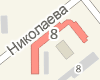 |
Institute of Philology Nikolaeva st., 8, Novosibirsk, 630090, Russian Federation +7-383-330-15-18, ifl@philology.nsc.ru |
© Institute of Philology |