 |
|
||||||||||||
|
Institute of Philology of
the Siberian Branch of Russian Academy of Sciences |
|
||||||||||||
|
|||||||||||||


 | |
| Sibirskii Filologicheskii Zhurnal (Siberian Journal of Philology) | |
| |
|
Article
Authors: Karina Kasymova Ural Federal University, Ekaterinburg, Russian Federation In the section Study of literature
Abstract: This paper examines the interviews of Vladimir Nabokov from the 1950s through the 1970s, specifically investigating public declarations that elucidate his self-identification as a “Russian writer.” The study explores his relationship with his national and cultural genesis, as well as his perception of Russia. The research is based on the interviews collected in the volume “Nabokov o Nabokove i prochem: interv’yu, retsenzii, esse” (“Nabokov on Nabokov and other things: interviews, reviews, essays”), compiled by N. Melnikov. The study concludes that when addressing his status as “still” or “also” a Russian writer, Nabokov structured his statements to avoid both definitive agreement and categorical denial. To craft his literary persona, he occasionally, and indirectly, linked himself to the Russian tradition through specific figures such as Nikolai Gogol. Nabokov’s stance toward contemporary Soviet Russia was characterized by a deep-seated refusal to engage with Soviet reality, which he contrasted with an idealized, mnemonic image of the Russia of his childhood. Despite his conviction that a physical return to his home-land was impossible, Nabokov maintained a belief in an eventual, albeit significantly delayed, recognition by the Russian readership he had lost. Keywords: V. Nabokov, interviews, public statements of writers, Russian literature, literature of the Russian diaspora, Soviet literature, Soviet Union, censorship Bibliography: Adamovich G. Rets.: “Sovremennye zapiski”, kniga 42 [Rew.: “Sovremennye zapiski”, Book 42]. In Klassik bez retushi. Literaturnyy mir o tvorchestve Vladimira Nabokova: Kriticheskie otzyvy, esse, parodii [The classic without retouching. The literary world of the works of Vladimir Nabokov: Critical reviews, essays, parodies]. N. G. Mel’nikov (Ed.). Moscow, NLO, 2000, pp. 61–62. Anastas’ev N. Vladimir Nabokov. Odinokiy korol’ [Vladimir Nabokov. The lonely king]. Moscow, Tsentrpoligraf, 2002, 525 p. Averin B. Dar Mnemoziny: Romany Nabokova v kontekste russkoy avtobiograficheskoy traditsii [The gift of Mnemosyne: Nabokov’s novels in the context of the Russian autobiographical tradition]. St. Petersburg, Amfora, 2003, 399 p. Blyum A. V. “Poetik belyy, Sirin...” (Nabokov o tsenzure i tsenzura o Nabokove) [“A white poetaster, Sirin…” (Nabokov on censorship and censorship on Nabokov)]. Zvezda. 1999, no. 4, pp. 198–203. Blyum A. V. Kak eto delalos’ v Leningrade. Tsenzura v gody ottepeli, zastoya i perestroyki. 1953–1991 [How it was done in Leningrad. Censorship in the years of thaw, stagnation, and perestroika. 1953–1991]. St. Petersburg, Akademicheskiy proekt, 2005, 296 p. Boyd B. Vladimir Nabokov: amerikanskie gody: Biografiya [Vladimir Nabokov: the American years: a biography]. Translation from English. St. Petersburg, Simpozium Publ., 2010, 950 p. Dolinin A. Istinnaya zhizn’ pisatelya Sirina: Raboty o Nabokove [The real life of the writer Sirin: Works on Nabokov]. St. Petersburg, Akademicheskii proekt, 2004, 400 p. Khodasevich V. O Sirine [About Sirin]. In Klassik bez retushi. Literaturnyy mir o tvorchestve Vladimira Nabokova: Kriticheskie otzyvy, esse, parodii [The classic with-out retouching. The literary world of the works of Vladimir Nabokov: Critical reviews, essays, parodies]. N. G. Mel’nikov (Ed.). Moscow, NLO, 2000, pp. 219–224. Matveeva M. V. Dialog kul’tur v angloyazychnoy proze V. V. Nabokova [The dialogue of cultures in the English-language prose of V. V. Nabokov]. Abstract of Cand. culturology diss. Shuya, 2010, 23 p. Mel’nikov N. G. Preambula k podborke retsenzii na “Lolitu” [A preamble to a collection of reviews of “Lolita”]. In Klassik bez retushi. Literaturnyy mir o tvorchestve Vladimira Nabokova: Kriticheskie otzyvy, esse, parodii [The classic without retouching. The literary world of the works of Vladimir Nabokov: Critical reviews, essays, parodies]. N. G. Mel’nikov (Ed.). Moscow, NLO, 2000, pp. 258–268. Mel’nikov N. Seans s razoblacheniem, ili Portret khudozhnika v starosti [A session with exposure, or a portrait of the artist as an old man]. In O Nabokove i prochem: stat’i, retsenzii, publikatsii [About Nabokov and other things: articles, reviews, publications]. N. G. Mel’nikov (Ed.). Moscow, Novoe literaturnoe obozrenie, 2014, pp. 142–171. Osorgin M. Rets.: Korol’, dama, valet. Berlin: Slovo, 1928 [Rew.: King, Queen, Knave. Berlin: Slovo, 1928]. In Klassik bez retushi. Literaturnyy mir o tvorchestve Vladimira Nabokova: Kriticheskie otzyvy, esse, parodii [The classic without retouching. The literary world of the works of Vladimir Nabokov: Critical reviews, essays, parodies]. N. G. Mel’nikov (Ed.). Moscow, NLO, 2000, pp. 40–42. Plotnikova E. V. Bilingvizm kul’tur v tvorcheskom nasledii V. V. Nabokova [Bilingualism of cultures in the creative heritage of V. V. Nabokov]. Abstract of Cand. culturology diss. Moscow, 2004, 23 p. Shrayer M. D. Nabokov: Temy i variatsii [Nabokov: Themes and variations]. St. Petersburg, Akademicheskiy proekt, 2000, 384 p. Struve G. Tvorchestvo Sirina [Sirin’s creativity]. In Klassik bez retushi. Literaturnyy mir o tvorchestve Vladimira Nabokova: Kriticheskie otzyvy, esse, parodii [The classic without retouching. The literary world of the works of Vladimir Nabokov: Critical reviews, essays, parodies]. N. G. Mel’nikov (Ed.). Moscow, NLO, 2000, pp. 181–186. Tammi P. Zametki o poligenetichnosti v proze Nabokova [Notes on polygenetics in Nabokov’s prose]. In V. V. Nabokov: pro et contra. Lichnost’ i tvorchestvo Vladimira Nabokova v otsenke russkikh i zarubezhnykh mysliteley i issledovateley. Antologiya [V. V. Nabokov: pro et contra. The personality and work of Vladimir Nabokov as assessed by Russian and foreign thinkers and researchers. Anthology]. St. Petersburg, Russian Christian Humanitarian Institute, 1997, pp. 514–528. Tsetlin M. V. Sirin. Vozvrashchenie Chorba. Rasskazy i stikhi, 1930 [The Return of Chorb. Short Stories and poems, 1930]. In V. V. Nabokov: pro et contra. Lichnost’ i tvorchestvo Vladimira Nabokova v otsenke russkikh i zarubezhnykh mysliteley i is sledovateley. Antologiya [V. V. Nabokov: pro et contra. The personality and work of Vladimir Nabokov as assessed by Russian and foreign thinkers and researchers. Anthology]. St. Petersburg, Russian Christian Humanitarian Institute, 1997, pp. 218–219. Virolainen M. Angloyazychie Nabokova kak inobytie russkoy slovesnosti [Nabokov’s English-speaking as an other-being of Russian literature]. In V. V. Nabokov: pro et contra. Materialy i issledovaniya o zhizni i tvorchestve V. V. Nabokova. Antologiya [V. V. Nabokov: pro et contra. Materials and research on the life and work of V. V. Nabokov. Anthology]. St. Petersburg, Russian Christian Humanitarian Institute, 2001, pp. 261–269. |


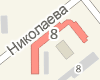 |
Institute of Philology Nikolaeva st., 8, Novosibirsk, 630090, Russian Federation +7-383-330-15-18, ifl@philology.nsc.ru |
© Institute of Philology |