 |
|
||||||||||||
|
Institute of Philology of
the Siberian Branch of Russian Academy of Sciences |
|
||||||||||||
|
|||||||||||||


 | |
| Sibirskii Filologicheskii Zhurnal (Siberian Journal of Philology) | |
| |
|
Article
Authors: Andrey V. Sharavin, Oleg E. Voronichev, Svetlana I. Vidyushchenko Bryansk State Academician I. G. Petrovski University, Bryansk, Russian Federation In the section Study of literature
Abstract: The disengagement of Alexander Blok from symbolism did not imply a dismissal of artistic strategies that renew the relationship between previous eras and the current one. The Petersburg myth of emperor-demiurges resonates in “The Twelve” through the Red Guards’ march and Katka’s murder. This homicide serves as a ritual of sacrifice, pre-determining a “cleansing” necessary for the birth of a new history and transforming the mythological into the historical, a shift toward a harsh, masculine image of power. The study analyzes the linguistic frequency of the paronyms vpered (”forward”) and vperedi (”in front of”) as indicators of the Twelve and Christ, respectively. Christ and the Red Guards coexist in divergent dimensions: the eternal and the earthly, the timeless and the temporal. While Blok suggests that Christ’s presence reflects a readiness for the atonement of the Revolution’s transgressions, the Red Guards instinctively sense Christ’s extraneity. Their rejection of Him signals a defection toward the expectation of “the Other,” a human leader modeled after Peter the Great. This motif of the “Other” and the non-recognition of Christ, merely indicated by Blok, finds full realization in Yakov Golosovker’s “Sozhzhennyy roman” (“Burned novel”). The disappearance of Most High after a gunshot allows for a reinterpretation of Blok’s vperedi as a spatial breakaway, signaling that Jesus eventually leaves the apostles of the new faith. Ultimately, the divine story transforms into a human one through the energetic opposition between Christ (light) and the guards (material), who await a Peter-type leader. Keywords: Alexander Blok, the poem “The Twelve” St. Petersburg, history, myth, ritual, symbol Bibliography: Aleksandr Blok v vospominaniyakh sovremennikov: V 2 t. [Alexander Blok in the memoirs of contemporaries: in 2 vols.]. Moscow, Khudozh. lit., 1980, vol. 2, 527 p. Dolgopolov L. K. Proqulki s Blokom [Walks with Blok]. St. Petersburg, Nestor-Istoriya, 2019, 336 p. “Dvenadtsati” – vzqlyad iz 2000 goda [The finale of “The Twelve” – a view from 2000]. Znamya. 2000, no. 11, pp. 190–207. Esaulov I. A. Mistika pozdneqo A. Bloka [The mysticism of late A. Blok]. In Russkaia klassika novoe ponimanie [Russian classics: a new understanding]. St. Petersburg, Aleteyya, Istoricheskaya kniga, 2012, pp. 232–253. Evzlin M. Kosmogoniya i ritual [Cosmogony and ritual]. Moscow, Radiks, 1993, 337 p. Gorelov A. E. Groza nad solov’inym sadom [Thunderstorm over the nightingale garden]. 2nd ed., Leningrad, Sov. pisatel’, 1973, 608 p. Gryakalova N. Yu. Poema-misteriya “Dvenadtsat’” i zhanr “gorodskikh videniy” v tvorchestve Bloka [The mystery poem “Twelve” and the genre of “city visions” in the work of Blok]. In Aleksandr Blok: Issledovaniia i materialy [Alexander Blok: Research and materials]. St. Petersburg, Pushkinskiy Dom, 2020, iss. 6, pp. 5–26. Lisunov P. Pushkin – istorik Petra: “Istoriya Petra” v tvorcheskom soznanii Pushkina 1830-kh gg. [Pushkin – Historian of Peter: “The History of Peter” in Pushkin’s Creative Consciousness of the 1830s]. Cand. philol. sci. diss. Moscow, 1997, 171 p. Prikhod’ko I. S. Mifopoetika A. Bloka. [Mythopoetics of A. Blok]. Vladimir, 1994, 132 p. Sarnov B. Stalin i pisateli [Stalin and the writers]. Moscow, Eksmo, 2009, 832 p. Smirnov I. P. Genezis. Filosofskie ocherki po sotsiokul’turnoy nachinatel’nosti [Genesis. Philosophical essays on socio-cultural beginnings]. St. Petersburg, Aleteyya, 2006, 288 p. Solov’ev S. M. Publichnye chteniya o Petre Velikom [Public readings about Peter the Great]. Moscow, Nauka, 1984, 232 p. Takho-Godi E. A. “Sviataya Rus’” v poeme A. Bloka “Dvenadtsat’”: khudozhestvennyy i literaturno-filosofskiy kontekst [“Holy Russia” in Alexander Blok’s poem “The Twelve”: artistic and literary-philosophical context]. In Aleksandr Blok: Issledovaniia i materialy [Alexander Blok: Research and materials]. St. Petersburg, Pushkinskiy Dom, 2020, iss. 6, pp. 26–37. |


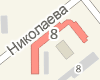 |
Institute of Philology Nikolaeva st., 8, Novosibirsk, 630090, Russian Federation +7-383-330-15-18, ifl@philology.nsc.ru |
© Institute of Philology |