 |
|
||||||||||||
|
Institute of Philology of
the Siberian Branch of Russian Academy of Sciences |
|
||||||||||||
|
|||||||||||||


 | |
| Sibirskii Filologicheskii Zhurnal (Siberian Journal of Philology) | |
| |
|
Article
Authors: Lyudmila I. Gorbunova Irkutsk State University, Irkutsk, Russian Federation In the section Linguistics
Abstract: This paper addresses two primary objectives. First, it provides a comprehensive description of the concept of LAW, a vital element of the Russian conceptual sphere verbalized by a diverse and highly frequent array of linguistic units. A multidimensional analysis is crucial due to the prevalent ambiguity surrounding this intricate concept among native speakers and researchers. Second, the study aims to refine the methodology of conceptual analysis. To guarantee verifiable findings, the research integrates a quantitative methodology with semantic analysis of dictionary entries and contexts derived from the Russian National Corpus. The conceptual-logical component of LAW encompasses: “a rule governing a specific sphere of socio-political relations,” “the codification of the rule in legislative documents,” and “the necessity of compliance.” Conversely, the notion of “punishment for violation” emerges only as a peripheral element. Spatially, the law is conceptualized as a physical object or boundary, not an insurmountable obstacle. The act of operating within legal parameters receives positive assessment, with its existence deemed necessary and beneficial and its absence associated with highly reprehensible phenomena. The primary figurative component anthropomorphizes the law as a sentient being, fully developed in terms of mental, emotional, volitional, and speech characteristics, alongside a defined social status. Consequently, it is conceptualized ambivalently: it establishes rules, protects, and patronizes, yet also restricts, dictates, and punishes. Axiologically, the law is recognized as an absolute value, notwithstanding its ambivalent position on the value scale. Ultimately, the paper challenges the assumption that native Russian speakers interpret the law strictly negatively. Keywords: the concept of “law”, Russian language, methodology of conceptual analysis, logical component of the concept, axiological component of the concept, figurative component of the concept Bibliography: Aktivnyy slovar’ russkogo yazyka [Active dictionary of the Russian language]. Moscow, St. Petersburg, Nestor-Istoriya, 2017, vol. 3: D–Z, 768 p. Andreeva I. V. Kontsepty “svoboda”, “spravedlivost’”, “zakon”, “rodina” v kartine mira russkikh i amerikantsev [The concepts of “freedom”, “justice”, “law”, and “homeland” in the worldviews of Russians and Americans]. Voprosy kul’turologii. 2007, no. 4, pp. 11–14. Antologiya kontseptov [Anthology of concepts]. V. I. Karasik, I. A. Sternin (Eds.). Volgograd, Paradigma, 2005, vol. 1, 352 p. Baydavletova L. R. Kontsept “pravda – spravedlivost’” v russkoy yazykovoy kartine mira (na materiale frazeologii) [The concept of “truth-justice” in the Russian language (picture of the world based on phraseology)]. Vestnik Ufimskogo yuridicheskogo instituta MVD Rossii [Bulletin of the Ufa Law Institute of the Ministry of Internal Affairs of Russia]. 2016, no. 3, pp. 92–98. Beglova E. I. Frazeologicheskie edinitsy v antinomii “zakon – prestuplenie” v russkoy yazykovoy kartine mira [Phraseological units in the antinomy “law – crime” in the Russian linguistic picture of the world]. Vestnik Ufimskogo yuridicheskogo instituta MVD Rossii [Bulletin of the Ufa Law Institute of the Ministry of Internal Affairs of Russia]. 2021, no. 1 (91), pp. 158–165. Dal’ V. I. Poslovitsy russkogo naroda [Proverbs of the Russian people]. Moscow, Azbuka, 2011, 304 p. Kolesov V. V., Kolesova D. V., Kharitonov A. A. Slovar’ russkoy mental’nosti [Dictionary of Russian mentality]. St. Petersburg, 2014, vol. 1, 592 p. Nikaeva T. M., Sizykh A. A. Sistema assotsiatsiy “zakon” i “prestuplenie” v yazykovom soznanii studentov [The system of associations “law” and “crime” in the linguistic consciousness of students]. Philological Sciences. Issues of Theory and Practice. 2020, vol. 13, no. 6, pp. 234–237. Petrenko E. E., Uryupina G. P. Verbalizatsiya kontseptov “zakon” i “chelovek” frazeologicheskimi sinonimami angliyskogo i russkogo yazykov [Verbalization of the concepts “law” and “man” by phraseological synonyms of the English and Russian languages]. In Aktual’nye problemy lingvistiki i metodiki prepodavaniya inostrannykh yazykov: materialy Mezhdunar. nauch.-prakt. konf. (Omsk, 27 aprelya 2018 g.) [Current problems of linguistics and methods of teaching foreign languages: Proceedings of the Intern. sci. and pract. conf. (Omsk, April 27, 2018)]. Omsk, 2018, pp. 181–185. Popova L. V. Pravda – spravedlivost’ i zakon v russkoy yazykovoy kartine mira: diakhronicheskiy aspekt [Truth, justice, and law in the Russian linguistic worldview: a diachronic aspect]. Bulletin of Chelyabinsk State University. 2021, no. 9 (455), pp. 128–134. Slovar’ russkogo yazyka: v 4 t. [Russian language dictionary: in 4 vols.]. A. P. Evgen’yeva (Ed.). Moscow, Rus. yaz., Poligrafresursy, 1999. Stepanov Yu. S. Konstanty: slovar’ russkoy kul’tury [Constants: a dictionary of Russian culture]. 3rd ed., rev. and enl. Moscow, Akademicheskiy proekt, 2004, 992 p. Tikhonov A. N. Slovoobrazovatel’nyy slovar’ russkogo yazyka [Word-formation dictionary of the Russian language]. Moscow, AST, 2003, vol. 1, 865 p. Volkov V. V. Leksema “zakon” i kontsept “zakon” v russkoy yazykovoy kartine mira [The lexeme law and the concept “law” in the Russian linguistic picture of the world]. Language and Culture. 2014, no. 11, pp. 173–177. Vorkachev S. G. Pravdy ishchi: ideya spravedlivosti v russkoy lingvokul’ture [Seek the truth: the idea of justice in Russian linguistic culture]. Volgograd, 2009, 190 p. Zaliznyak A. A., Levontina I. B., Shmelev A. D. Klyuchevye idei russkoy yazykovoy kartiny mira [Key ideas of the Russian linguistic picture of the world]. Moscow, LRC Publishing House, 2005, 540 p. |


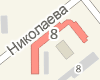 |
Institute of Philology Nikolaeva st., 8, Novosibirsk, 630090, Russian Federation +7-383-330-15-18, ifl@philology.nsc.ru |
© Institute of Philology |