 |
|
||||||||||||
|
Institute of Philology of
the Siberian Branch of Russian Academy of Sciences |
|
||||||||||||
|
|||||||||||||


 | |
| Sibirskii Filologicheskii Zhurnal (Siberian Journal of Philology) | |
| |
|
Article
Authors: Mengi V. Ondar Peter the Great Museum of Anthropology and Ethnography (Kunstkamera) of the Russian Academy of Sciences, St. Petersburg, Russian Federation In the section Linguistics
Abstract: This paper presents a comparative analysis of high-frequency adjectives in Tuvan and Buryat heroic epics. The research material comprises the texts of Boktu-Kirish, Bora-Sheeley (Tuvan epic) and Alamzhi Mergen (Buryat epic). The objective is to determine the most frequently occurring adjectives in the designated epics and to elucidate their definitions, offering insight into the complete linguistic and, notably, folkloric worldview of the Turkic-Mongolian peoples. The analysis establishes that the most frequent adjectives in both texts are ‘white’, ‘black’, ‘golden’, and ‘silver’, all of which exhibit complex polysemy. While the semantic structures of these adjectives share common core elements, a detailed examination reveals specific national characteristics that shape the linguistic worldview of each ethnic group. For instance, in the Buryat epic, the adjective ‘white’ is closely associated with ‘silver’, which serves as the highest-frequency lexeme among the color adjectives. In the Tuvan epic, ‘white’ is associated with strength, characterizing the physical abilities of the heroes. The numerous meanings of the adjective ‘black’–such as ‘rich’, ‘noble’, and ‘foreign’–are evident in both Tuvan and Buryat traditions. Further commonality is found in the use of the adjective ‘red’, which is associated with ‘movement, energy, and aggression’ in the epic texts of the Turkic-Mongolian peoples. Finally, the adjective ‘golden’ appears more frequently in the Tuvan text than in the Buryat one, where it is strongly associated with the sun–a key cult object in the national worldview of the Tuvans. Keywords: Tuvan epic, Buryat epic, adjectives, linguistic picture of the world, national peculiarities Bibliography: Bakchiev T. A. Interpretatsiya nekotorykh simvolov v epose “Manas” [Interpretation of some symbols in the epic “Manas”]. Vestnik Buryatskogo gosudarstvennogo universiteta. Gumanitarnyye issledovaniya Vnutrenney Azii. 2017, iss. 1, pp. 9–14. Beregova O. Simvoly slavyan [Symbols of the Slavs]. St. Petersburg, DILYa, 2016, 432 p. Bol’shoy akademicheskiy mongol’sko-russkiy slovar’ [BAMRS – Large academic Mongolian-Russian dictionary]. G. Ts. Pyurbeev (Ed.). Moscow, Academia, 2001, vol. 1: A–G, 520 p. Darzha V. K. Tayny mirovozzreniya tuvintsev-nomadov [The secrets of the Tuvan nomad worldview]. Kyzyl, Pravnik+, 2016, 255 p. Gabysheva L. L. Fol’klornyy tekst: semioticheskiye mekhanizmy ustnoy pamyati [Folklore text: semiotic mechanisms of oral memory]. Novosibirsk, Nauka, 2009, 143 p. Gabysheva L. L. Simvolicheskoye znacheniye nominatsiy metallov v epose yakutov i drugikh tyurkskikh narodov [The symbolic meaning of metal nominations in the epic of the Yakuts and other Turkic peoples]. Vestnik Severo-Vostochnogo federal’nogo universiteta im. M. K. Ammosova. 2012, vol. 9, no. 3, pp. 115–120. Gachev G. D. Natsional’nyye obrazy mira: obshchiye voprosy: russkiy, bolgarskiy, kirgizskiy, gruzinskiy, armyanskiy [National images of the world: general questions: Russian, Bulgarian, Kyrgyz, Georgian, Armenian]. Moscow, Kniga po trebovaniyu, 2013, 234 p. Iskhakov F. G., Pal’mbakh A. A. Grammatika tuvinskogo yazyka. Fonetika i morfologiya [Grammar of the Tuvan language. Phonetics and morphology]. Moscow, Vost. lit., 1961, 471 p. Khertek L. K. Mifologicheskiye traditsii v tuvinskikh geroicheskikh skazaniyakh (syuzhety i obrazy) [Mythological traditions in Tuvan heroic tales (plots and images)]. Kyzyl, TuvSU Press, 2014, 183 p. Kornilov O. A. Yazykovyye kartiny mira kak proizvodnyye natsional’nykh mentalitetov: Ucheb. posobiyev [Linguistic worldviews as derivatives of national mentalities: a textbook]. Moscow, KDU, 2019, 348 p. Orus-ool S. M. Tuvinskiye geroicheskiye skazaniya (tekstologiya, poetika, stil’) [Tuvan heroic tales (textology, poetics, style)]. Moscow, MAKSPress, 2001, 422 p. Pyurbeev G. Ts. Epos “Dzhangar”: kul’tura i yazyk [The epic “Dzhangar”: culture and language]. Elista, Kalm. kn. izd., 1993, 128 p. Robbek L. V. Leksiko-semanticheskiye osobennosti yazyka yakutskogo geroicheskogo eposa olonkho [Lexico-semantic features of the language of the Yakut heroic epic olonkho]. Novosibirsk, Nauka, 2014, 140 p. Serov N. V. Simvolika tsveta [The symbolism of color]. St. Petersburg, Strata, 2019, 196 p. Tatarintsev B. I. O nekotorykh gruppakh mongolizmov v yazyke tuvinskogo fol’klora (na materiale skazok i geroicheskikh skazaniy) [About some groups of Mongolisms in the language of Tuvan folklore (based on fairy tales and heroic tales)]. In Tatarintsev B. I. Izbrannyye nauchnyye trudy [Selected scientific works]. Kyzyl, Tyvapoligraf, 2009, pp. 68–82. Timofeev L. I. Tvorchestvo Aleksandra Bloka [The work of Alexander Blok]. Vaynshteyn S. I. Istoriya narodnogo iskusstva Tuvy [The history of Tuvan folk art]. Moscow, Nauka, 1974, 223 p. Voytenko E. P. Obraznyye yazykovyye sredstva v khakasskom i russkom epose (na materiale khakasskogo geroicheskogo eposa “Ay-Khuuchin” i russkikh bylinnykh tekstov Sibiri i Dal’nego Vostoka) [Figurative language tools in Khakass and Russian epics (based on the material of the Khakass heroic epic “Ay-Khuuchin” and Russian epic texts of Siberia and the Far East)]. Abstract of Cand. philol. sci. diss. Novosibirsk, 2010, 27 p. Zhukovskaya N. L. Kochevniki Mongolii: kul’tura. Traditsii. Simvolika [Nomads of Mongolia: culture. Traditions. Symbolism]. Moscow, Vost. lit. RAN, 2002, 247 p. |


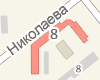 |
Institute of Philology Nikolaeva st., 8, Novosibirsk, 630090, Russian Federation +7-383-330-15-18, ifl@philology.nsc.ru |
© Institute of Philology |