 |
|
||||||||||||
|
Institute of Philology of
the Siberian Branch of Russian Academy of Sciences |
|
||||||||||||
|
|||||||||||||


 | |
| Sibirskii Filologicheskii Zhurnal (Siberian Journal of Philology) | |
| |
|
Article
Authors: Tatyana R. Ryzhikova Institute of Philology of the Siberian Branch of the Russian Academy of Sciences, Novosibirsk, Russian Federation In the section Linguistics
Abstract: This study marks the first investigation into the phonetic features of stress in the Barabian language, using a substantial body of experimental acoustic findings. As observed in the majority of Turkic languages, stress in Barabian most frequently falls on the final syllable and progressively shifts toward the end of the word during suffixation. However, the analysis identifies a specific set of affixes that trigger atypical stress placement. Following the phonetic framework of L. R. Zinder, this study distinguishes between dynamic stress (intensity) and force stress (articulatory tension). The distribution of intensity within a word cannot be considered a reliable correlate of Barabian stress, primarily because strict phonological rules governing its distribution have not been formulated. Stress and intonation share similarities in their tonal qualities because they both function at the suprasegmental level and occur together within a spoken phrase. The stressed syllable in Barabian is characterized not by a simple rise or fall in the fundamental frequency but rather by a distinctive “break” in tone direction. The vocal system of Barabian comprises only nine vowel phonemes, contrasted by backness and height, with length not being a distinguishing factor. Nonetheless, “positional lengthening” does happen, a characteristic feature found in various Siberian Turkic languages. Given that vowel length does not possess phonemic status and is only manifested under particular phonetic circumstances, it cannot function as a stress correlate. Based on these findings, it is concluded that stress in the Barabian language is bound, mobile, weakly centralized, and tonal regarding a directional tone break. Keywords: stress, intensity, vowel length, fundamental frequency, suprasegmental phonetics, Turkic languages, the Barabian language Bibliography: Alekseev I. E. Slova s udareniyem na pervom i seredinnom slogakh v yakutskom yazyke [Words with stress on the first and middle syllables in the Yakut language]. In Issledovaniya po yakutskoy grammatike i dialektologii [Studies on Yakut grammar and dialectology]. Yakutsk, 1979, pp. 22–39. Alekseev-Khomus Uybaan I. E. Problemy fonosintaksisa yakutskoy rechi [Problems of phonosyntax of Yakut speech]. Yakutsk, SVFU, 2022, 365 p. Andreeva T. E. Slovesnoye udareniye v evenkiyskom yazyke: eksperimental’no-foneticheskoye issledovaniye na materialakh govorov evenkov Yakutii [Verbal stress in the Evenki language: experimental-phonetic study based on dialect material of the Evens of Yakutia]. Novosibirsk, Nauka, 2001, 151 p. Badanova T. A. Slovesnoye udareniye v altayskom yazyke v sopostavitel’nom aspekte [Verbal stress in the Altai language in a comparative aspect]. Novosibirsk, NSU Press, 2011, 316 p. Baichura U. Sh. Instrumental’no-foneticheskiye dannyye otnositel’no intonatsii i slovesnogo udareniya v tyurkskikh yazykakh [Instrumental-phonetic data on intonation and word stress in Turkic languages]. In Proceedings of the Sixth International Congress of Phonetic Sciences. Prague, Academia Publishing House of the Czechoslovak Academy of Sciences, 1970, pp. 147–167. Baichura U. Sh. Instrumental’nyye dannyye ob udarenii i intonatsii v altayskikh yazykakh [Instrumental data on stress and intonation in Altaic languages]. In Problema obshchnosti altayskikh yazykov [The problem of the unity of Altaic languages]. Leningrad, Nauka, 1971, pp. 279–292. Dmitrieva L. V. Yazyk barabinskikh tatar [The language of the Baraba Tatars]. Leningrad, Nauka, 1981, 225 p. Dobrynina A. A., Selyutina I. Ya., Shindrova K. V., Karataev A. V. Pozitsionno-kombinatornyye usloviya kvantitativnogo var’irovaniya glasnykh v tyurkskikh yazykakh Altaya [Positional combinatorial conditions of vowel length variation in Turkic languages of Altai]. Sibirskii Filologicheskii Zhurnal [Siberian Journal of Philology]. 2025, no. 2, pp. 128–144. Makhmudov A. Sootnosheniye singarmonizma, udareniya i zvukovogo stroya yazyka [The correlation of vowel harmony, stress, and phonological structure of a language]. In Tyurkskoye yazykoznaniye: materialy III tyurkologicheskoy konferentsii [Turkic linguistics: Proceedings of the III Turkological conference]. Tashkent, 1985, pp. 292–296. Morozova O. N. Paradigmatika i sintagmatika zvukovykh sistem tungusskikh yazykov Verkhnego Priamur’ya (na materiale evenkiyskogo i orochonskogo yazykov) [Paradigmatics and syntagmatics of the sound systems of Tungus languages of Upper Priamurye (based on material of the Evenki and Orochon languages)]. Abstract of Dr. philol. sci. diss. Novosibirsk, 2021, 45 p. Nurmuhammedov A. O vzaimootnoshenii singarmonizma i slovesnogo udareniya (na materiale turkmenskogo i nekotorykh drugikh yazykov) [On the relationship between vowel harmony and word stress (based on Turkmen and some other languages)]. Rossiyskaya tyurkologiya. 2022, no. 1–2 (34–35), pp. 46–56. Paschen L., Fuchs S., Seifart F. Final lengthening and vowel length in 25 languages. Journal of Phonetics. 2022, no. 94, pp. 101179–101202. Ryzhikova T. R. Artikulyatornyye kharakteristiki glasnykh fonem yazyka barabinskikh tatar (po dannym magnitno-rezonansnoy tomografii) [Articulatory features of vowel phonemes of the Baraba Tatars language (according to MRI data)]. In Vokalizm zvuchashchey rechi narodov Rossii i zarubezh’ya: k 50-letiyu Amurskogo gosudarstvennogo universiteta, v ramkakh provedeniya sovmestnykh Godov kul’tury Rossii i Kitaya (2024–2025), mezhdunarodnogo Desyatiletiya yazykov korennykh malochislennykh narodov (2022–2032) [Vocalism of the sounding speech of the peoples of Russia and abroad: to the 50th anniversary of Amur State University, within the framework of the joint Years of Culture of Russia and China (2024–2025), the international Decade of Indigenous Languages (2022–2032)]. Blagoveshchensk, AmSU, 2024, pp. 66–80. Ryzhikova T. R., Dobrinina A. A., Timkin T. V. Izucheniye preryvistykh glasnykh surgutskogo dialekta khantyyskogo yazyka metodom pryamoy tsifrovoy laringoskopii: predvaritel’nyye rezul’taty [Study of intermittent vowels of the Surgut dialect of Khanty language by direct digital laryngoscopy: preliminary results]. Bulletin of Ugric Studies. 2021, vol. 11, no. 1, pp. 102–111. Sagidullin M. A. Fonetika i grafika sovremennogo sibirskotatarskogo yazyka [Phonetics and graphics of the modern Siberian Tatar language]. Tyumen, Isker, 2008, 64 p. Selyutina I. Ya. Kumandinskiy vokalizm. Eksperimental’no-foneticheskoye issledovaniye [Kumandin vocalism. Experimental-phonetic study]. Novosibirsk, Nauka, 1998, 184 p. Selyutina I. Ya., Urtegeshev N. S., Dobrinina A. A., Ryzhikova T. R., Fedina N. N. Problema dolgoty glasnykh v tyurkskikh yazykakh Sibiri: pozitsionnaya dlitel’nost’ [The problem of vowel length in Turkic languages of Siberia: positional lengthening]. In Tyurkskiye arealy Sibiri: pamyati N. N. Shirobokovoy posvyashchayetsya [Turkic areas of Siberia: dedicated to the memory of N. N. Shirobokova]. Novosibirsk, Akademizdat, 2022, pp. 100–143. Vinogradov V. A. Udareniye [Stress]. In Lingvisticheskiy entsiklopedicheskiy slovar’ [Linguistic encyclopedic dictionary]. V. N. Yartseva (Ed.). 1990. URL: https://rus-yaz.niv.ru/doc/dictionary/linguistic-encyclopedic/articles/201/udarenie.htm (accessed 23.05.2026). Zinder L. R. Obshchaya fonetika: ucheb. posobiye [General phonetics: textbook]. Moscow, Vyssh. shk., 1979, 312 p. Zinder L. R. Voprosy fonetiki (popul. ocherk) [Questions of phonetics (popular sketch)]. Leningrad, Leningr. gos. un-t, 1948, 56 p. |


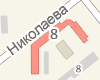 |
Institute of Philology Nikolaeva st., 8, Novosibirsk, 630090, Russian Federation +7-383-330-15-18, ifl@philology.nsc.ru |
© Institute of Philology |