 |
|
||||||||||||
|
Institute of Philology of
the Siberian Branch of Russian Academy of Sciences |
|
||||||||||||
|
|||||||||||||


 | |
| Sibirskii Filologicheskii Zhurnal (Siberian Journal of Philology) | |
| |
|
Article
Authors: Liu Gaochen Peking University, Beijing, China In the section Study of literature
Abstract: This paper examines the literary mystification of Arno Tsart, a fictional Estonian poet created within the Leningrad samizdat of the late Soviet period. Initiated by the poet E. A. Shvarts, the project soon evolved into a collective mystification joined by V. B. Krivulin, S. G. Stratanovsky, and A. N. Mironov. Unlike traditional mystifications, which are typically limited to stylizing a fictional author, this project relied on a two-stage modeling process. Shvarts initially established Tsart and Lisa as central figures, while subsequent authors expanded upon them, adding new meanings, interpretations, and contexts. Shvarts’s works seamlessly blend the romantic epic genre with metapoetic reflections, exploring the connection between love and creativity as processes capable of generating, transforming, and destroying one another. Lisa, the central female character, unites elements of Eastern mythology and Christian tradition, becoming a symbol of creative inspiration through her inherently ambivalent nature. Krivulin’s texts, in turn, develop the socio-critical trajectory of the mystification, transforming Tsart into an allegory of an oppressed creator resisting normative control. His oeuvre functions as a contemplation on the essence of artistic expression, underscoring the susceptibility of creativity to institutional limitations, while simultaneously acknowledging its inherent ability for regeneration. Ultimately, the Arno Tsart mystification represents not only a literary experiment but also a significant cultural manifesto of the samizdat movement. This literary mask enabled the authors to rethink traditional notions of authorship, transcend dogmatic frameworks, and expand the horizons of artistic expression. Samizdat, with its inherently postmodern and playful nature, served as an ideal platform for such experiments, turning mystification into an instrument of intellectual resistance. Keywords: mystification, Arno Tsart, samizdat, Journal Obvodny Kanal, E. A. Shvarts, V. B. Krivulin, postmodernism, metapoetics Bibliography: Ayzenshteyn E. O. Kh’yumbi-poet, ili Tsvetnyye angely Eleny Shvarts [Hiumby-Poet, or the colored angels of Elena Schwartz]. Neva. 2015, no. 5, pp. 183–209. Butyrin K. M. (Mamontov K.) Son v zimnyuyu noch’, ili Yavleniye Tsarta [A dream on a winter night, or the appearance of Tsart]. Obvodnyy kanal. 1982, no. 3, pp. 204–209. Derrida J. O grammatologii [Of grammatology]. N. Avtonomova (Trans., Intro.). Moscow, Ad Marginem, 2000, 511 p. Derrida J. Pis’mo i razlichiye [Writing and difference]. A. Garadzha, V. Lapitskiy, S. Fokin (Trans.). St. Petersburg, Akademicheskiy proekt, 2007, 494 p. Grishunin A. L. Mistifikatsii literaturnyye [Literary mystifications]. In Kratkaya literaturnaya entsiklopediya: v 9 t. [Brief literary encyclopedia: in 9 vols.]. A. A. Surkov (Ed.). Moscow, Sov. entsiklopediya, 1967, vol. 4: Lakshin – Muranovo, pp. 865–868. Khabibullina M. N. Svoyeobraziye zhanra “malen’koy poemy” E. Shvarts (na primere poemy “Sochineniya Arno Tsarta”) [The peculiarities of the genre of the “small poem” by E. Schwartz (on the example of the poem “The writings of Arno Tsart”)]. In Dergachevskiye chteniya: materialy X Vseros. nauch. konf. [Dergachev readings: Proceedings of the 10th All-Russian scientific conference]. Ekaterinburg, 2012, vol. 2, pp. 372–376. Kostalevskaya M. I. Duet, diada, duel’ (“Motsart i Sal’eri”) [Duet, diad, duel (“Mozart and Salieri”)]. In Moskovskiy pushkinist: yezhegod. sb. [Moscow Pushkin scholar: annual collection]. V. S. Nepomnyashchiy (Comp., Ed.). Moscow, Naslediye, 1996, iss. 2, pp. 40–56. Kovaleva N. Yu. Arno Tsart i drugiye (iz istorii mistifikatsiy) [Arno Tsart and others (from the history of mystifications)]. Samizdat. 2001. URL: http://samlib.ru/k/ kowalewa_n_j/arnozartidrugie-1.shtml (accessed 01.01.2025). Losev L. V. Upornaya zhizn’ Dzhemsa Klifforda: vozvrashcheniye odnoy mistifikatsii [The persistent life of James Clifford: the return of a mystification]. Zvezda. 2001, no. 1, pp. 184–192. Poety, kotorykh ne bylo… [The poets who never existed…]. I. Fonyakov (Comp., Notes). 2nd ed., rev. and enl. St. Petersburg, N. Kupriyanov Publ., Znak, 2005, 287 p. Popova I. L. Literaturnaya mistifikatsiya v istoriko-funktsional’nom aspekte [Literary mystification in the historical-functional aspect]. Abstract of Cand. philol. sci. diss. Moscow, 1992, 18 p. Samizdat Leningrada. 1950-ye – 1980-ye. Literaturnaya entsiklopediya [Leningrad samizdat. 1950s–1980s. Literary encyclopedia]. V. E. Dolinin, B. I. Ivanov, B. V. Ostanin, D. Ya. Severyukhin (Comps.), D. Ya. Severyukhin (Ed.). Moscow, NLO, 2003, 624 p. Shubinskiy V. I. Dva “Arno Tsarta” [Two “Arno Tsarts”]. Kvarta. 2022, no. 2. URL: http://quarta-poetry.ru/two_zarts/ (accessed 01.01.2025). Shutova Yu. N. Literaturnaya mistifikatsiya kak rezul’tat realizatsii strategii zhiznetvorchestva pisateley serebryanogo veka [Literary mystification as a result of the realization of the life-creation strategy of Silver Age writers]. Cherepovets State University Bulletin. 2014, no. 3, pp. 152–155. Shutova Yu. N. Literaturnaya mistifikatsiya kak rezul’tat realizatsii strategii zhiznetvorchestva pisateley serebryanogo veka [Literary mystification as a result of the realization of the life-creation strategy of Silver Age writers]. Cherepovets State University Bulletin. 2014, no. 3, pp. 152–155. |


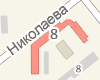 |
Institute of Philology Nikolaeva st., 8, Novosibirsk, 630090, Russian Federation +7-383-330-15-18, ifl@philology.nsc.ru |
© Institute of Philology |