 |
|
||||||||||||
|
Institute of Philology of
the Siberian Branch of Russian Academy of Sciences |
|
||||||||||||
|
|||||||||||||


 | |
| Sibirskii Filologicheskii Zhurnal (Siberian Journal of Philology) | |
| |
|
Article
Authors: Irina V. Shaposhnikova Institute of Philology of the Siberian Branch of the Russian Academy of Sciences, Novosibirsk, Russian Federation In the section Linguistics
Abstract: This paper examines a set of associative units that name people and function as ontological, system-forming dominants of the Russian linguistic personality. The study focuses on the diachronic shifts within the “I (me)–family–children” ontologeme, as well as the deictic units and kinship terms that mark role functions within the family. The comparative analysis is based on data from two major reverse associative dictionaries: the Russian Associative Dictionary (RAS, 1988–1997) and the Siberian Associative Dictionary (SIBAS 1+2, 2008–2022). By ranking associative dominants according to their number of incoming links and conducting functional tests on associative fields, the author identifies the intensity and direction of shifts in the mental lexicon. The material, collected through long-term associative experiments among students, reflects the dynamics of socio-communicative attitudes among Russian youth, from the Perestroika era to the early 2020s. The author employs chronoglossation to visualize the increasing or decreasing semantic weight of these dominants. These linguistic vectors are interpreted within the broader context of sociogenesis and compared with contemporary sociological data. Ultimately, the research highlights how the linguistic personality adapts its core ontological nodes in response to the profound sociocultural transformations of the last three decades, providing a map of the evolving Russian world-image. Keywords: Russian language personality, ontologemes, personal deixis, kinship terms, mental lexicon, associative dominants Bibliography: Akhutina T. V. Neyrolingvisticheskiy analiz leksiki, semantiki i pragmatiki [Neurolinguistic analysis of vocabulary, semantics, and pragmatics]. Moscow, LRC Publishing House, 2014, 424 p. (Razumnoe povedenie i yazyk [Language and reasoning]) Bubnova I. A. Spetsifika sovremennoy yazykovoy lichnosti v istoriko-etnicheskoy perspektive: psikholingvisticheskiy rakurs [The specificity of the modern linguistic personality in the historical and ethnic perspective: a psycholinguistic aspect]. Journal of Psycholinguistics. 2025, no. 3 (65), pp. 10–21. DOI 10.30982/2077-5911-2025-65-3-10-20 Bubnova I. A. Tsennosti i obraz budushchego pokoleniya Z: spetsifika sistemy [Values and the image of the future for generation z: the specificity of the system]. RUDN Journal of Language Studies, Semiotics and Semantics. 2021, vol. 12, no. 2, pp. 269–278. DOI 10.22363/2313-2299-2021-12-2-269-278 Dobrova G. R. Evolyutsiya lichnykh mestoimeniy i terminov rodstva v ontogeneze [Evolution of personal pronouns and kinship terms in ontogenesis]. Izvestia: Herzen University Journal of Humanities & Sciences. 2003, no. 3 (5), pp. 115–125. Dobrova G. R. Ontogenez personal’nogo “rechevogo” deyksisa [Ontogenesis of personal “speech” deixis]. Pedagogical Education in Russia. 2014, no. 5, pp. 163–168. Krasnykh V. V. Kontsept “Ya” v svete lingvokul’turologii [The “I”-concept in linguoculturology]. In Yazyk, soznanie, kommunikatsiya [Language, consciousness, communication]. V. V. Krasnykh, A. I. Izotov (Eds.). Moscow, MAKS Press, 2003, iss. 23, pp. 4–14. Leont’ev A. A. Lichnost’ kak istoriko-etnicheskaya kategoriya [Personality as a historical and ethnic category]. Sovetskaia Etnografia. 1981, no. 3, pp. 35–44. Malik E. N., Shediy M. V. Sem’ya i semeynye tsennosti – opora rossiyskoy gosudarstvennosti [Family and family values – the support of Russian statehood]. Bulletin of Russian nation. 2025, no. 1 (100), pp. 86–95. Pishchal’nikova V. A., Stepykin N. I. Izmenenie kharaktera preditsirovaniya v rechevom deystvii: eksperimental’noe issledovanie [Changes in nature of prediction in speech acts: an experimental study]. Nauchnyi dialog [Scientific Dialogue]. 2025, no. 14 (3), pp. 43–61. DOI 10.24224/2227-1295-2025-14-3-43-61 Sapogova E. E. Struktura lichnostnogo tezaurusa: ekzistentsial’no-psikhologicheskiy podkhod [The Structure of Personal Thesaurus: Existential Psychological Approach]. Sibirskiy psikhologicheskiy zhurnal [Siberian journal of psychology]. 2019, no. 73, pp. 40–59. DOI 10.17223/17267080/73/3 Ufimtseva N. V. Dukhovnyy sloy soznaniya i yego otrazhenie v assotsiativnykh bazakh dannykh (k postanovke problemy) [The spiritual layer of consciousness and its reflection in asociative databases (towards the formulation of the problem)]. Journal of Psycholinguistics. 2025, no. 4 (66), pp. 8–19. DOI 10.30982/2077-5911-2025-66-4-8-19 |


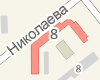 |
Institute of Philology Nikolaeva st., 8, Novosibirsk, 630090, Russian Federation +7-383-330-15-18, ifl@philology.nsc.ru |
© Institute of Philology |