 |
|
||||||||||||
|
Institute of Philology of
the Siberian Branch of Russian Academy of Sciences |
|
||||||||||||
|
|||||||||||||


 | |
| Sibirskii Filologicheskii Zhurnal (Siberian Journal of Philology) | |
| |
|
Article
Authors: Evgeniya E. Anisimova, Violetta S. Srmikyan Krasnoyarsk State Pedagogical University named after V. P. Astafyev, Krasnoyarsk, Russian Federation; Siberian Federal University Krasnoyarsk, Russian Federation In the section Study of literature
Abstract: This paper explores the contribution of Maximilian Voloshin to the development of the Krasnoyarsk “local text” and the “mapping” of Yenisei Siberia onto the broader cultural landscape of Russia. The focus is on Voloshin’s biography of the painter, Surikov (1916), examined within its historical and cultural context. The research demonstrates that, by turning to the Krasnoyarsk chapters of V. Surikov’s life, Voloshin adopted a narrative strategy unique to Siberian literature: a dialogical interplay between two distinct viewpoints. Surikov is presented as an autochthon (an insider), while the narrator provides an external perspective. This dual approach creates alternative depictions of Siberia, imbuing the biography with a profoundly dialogical character. The research identifies several key dominants of the Krasnoyarsk text. First, Voloshin portrays the Krasnoyarsk of the mid-to-late 19th century as a preserved fragment of Muscovite Rus’ from the 16th and 17th centuries, while Surikov himself is depicted as a figure from another era, a Russian Cossack of Yermak’s time. According to Voloshin, Russia’s past remained static in Siberia, allowing Surikov to develop within a pre-Petrine cultural atmosphere, which ultimately ensured the authenticity of his historical paintings. Second, Krasnoyarsk is presented through a dual historical-poetic retrospective. Surikov’s narrative is rooted in the traditions of the heroic epic, folktale, and skaz, whereas Voloshin’s perspective aligns with the literary discourse that historically portrayed Siberia as a “realm of cold and snow,” a place of exile and penal servitude. Keywords: M. A. Voloshin, V. I. Surikov, Krasnoyarsk, Siberian text, Siberian Cossacks, narrative, dialogue, modernism Bibliography: Anisimov K. V. Problemy poetiki literatury Sibiri 19 – nachala 20 veka: Osobennosti stanovleniya i razvitiya regional’noy literaturnoy traditsii [Problems of the poetics of Siberian literature in the 19th – early 20th centuries: features of the formation and development of the regional literary tradition]. Tomsk, 2005, 304 p. Benua A. N. Istoriya russkoy zhivopisi v 19 veke [History of Russian painting in the 19th century]. Moscow, Respublika, 1995, 448 p. Blazhes V. V. Fol’klor Urala: narodnaya istoriya o Ermake [Folklore of the Urals: a folk story about Ermak]. Yekaterinburg, Ural University Publishing House, 2002, 186 p. Kornienko S. Yu. Zemlya voli i boli: Sibir’ v poeticheskom voobrazhenii Konstantina Bal’monta i Mariny Tsvetaevoy [The land of will and pain: Siberia in the poetic imagination of Konstantin Balmont and Marina Tsvetaeva]. In Bal’mont K. D. Golubaya podkova. Stikhi o Sibiri [The Blue Horseshoe. Poems about Siberia]; Tsvetaeva M. I. Sibir’ [Siberia]. Novosibirsk, Otkrytaya kafedra, 2019, pp. 7–12. Kornienko S. Yu. Samoopredelenie v kul’ture moderna: Maksimilian Voloshin – Marina Tsvetaeva [Self–determination in modern culture: Maximilian Voloshin – Marina Tsvetaeva]. Moscow, LRC Publishing House, 2015, 418 p. Litovskaya M. A., Belimov V. N. Ekaterinburg raven vsemu Uralu. I v etom problema. Interv’yu [“Ekaterinburg is equal to the entire Urals. And therein lies the problem.” Interview]. Municipality: Economics and Management. 2021, no. 4, pp. 26–33. Shevelenko I. D. Modernizm kak arkhaizm: natsionalizm i poiski modernistskoy estetiki v Rossii [Modernism as archaism: nationalism and the search for modernist aesthetics in Russia]. Moscow, 2017, 333 p. Surikov V. I. Pis’ma. Vospominaniya o khudozhnike [Letters. Memories of the Artist]. Leningrad, 1977, Iskusstvo, 384 p. Tyupa V. I. Mifologema Sibiri: k voprosu o “sibirskom tekste” russkoy literatury [The Mythologeme of Siberia: on the question of the “Siberian text” of Russian literature]. Sibirskii Filologicheskii Zhurnal [Siberian Journal of Philology]. 2002, no. 1, pp. 28–35. Vasil’eva-Shlyapina G. L. Portret i kartina v tvorchestve V. I. Surikova [Portrait and painting in the work of V. I. Surikov]. Abstract of Art History Doctor Diss. St. Petersburg, 2002, 49 p. Voloshin M. A. Liki tvorchestva [Faces of creativity]. Leningrad, 1988, 848 p. Voloshin M. A. Sobranie sochineniy: V 17 t. [Collected works: in 20 vols]. Moscow, Ellis Luck, 2003–2015. Zamyatin D. N. Metageografiya: Prostranstvo obrazov i obrazy prostranstva [Metageography: The space of images and images of space]. Moscow, 2004, 512 p. Zvereva T. V. Surikovskiy sled v russkoy poezii 20 veka [Surikov’s trace in Russian poetry of the 20th century]. Philological Class. 2018, no. 1 (51), pp. 94–101. |


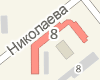 |
Institute of Philology Nikolaeva st., 8, Novosibirsk, 630090, Russian Federation +7-383-330-15-18, ifl@philology.nsc.ru |
© Institute of Philology |