 |
|
||||||||||||
|
Institute of Philology of
the Siberian Branch of Russian Academy of Sciences |
|
||||||||||||
|
|||||||||||||


 | |
| Sibirskii Filologicheskii Zhurnal (Siberian Journal of Philology) | |
| |
|
Article
Authors: Nikolai V. Anisimov, Irina V. Pchelovodova Estonian Literary Museum, Tartu, Estonia; Udmurt State University, Izhevsk, Russian Federation; Udmurt Federal Research Centre of the Ural Branch of the Russian Academy of Sciences, Izhevsk, Russian Federation In the section Study of folklore
Abstract: This paper examines the folklore heritage of the Udmurt songwriter Maria Pavlovna Nikonova, whose works represent a unique synthesis of traditional cultural canons and individual artistic expression. Employing biographical, contextual, philological, and ethnographic methods, the study explores the interplay between folk roots and personal voice within the performer’s “song autobiography.” The research demonstrates that the canons of Udmurt folklore are strongly reflected in songs connected with rites of passage (weddings, military inductions, funerals) or those addressing universal themes such as separation, youth, and aging. These works draw on characteristic imagery (the sun, birds, trees, rivers) and structural devices (repetition, parallelism) typical of Udmurt folk poetics. In contrast, songs composed during the most difficult periods of Nikonova’s life reveal a shift in which the personal perspective prevails over the traditional. These lyrics are marked by concrete documentary details names, geographical locations, and historical events that imbue the texts with individuality and evidentiary weight. By analyzing songs that span Nikonova’s childhood, adulthood, and old age, the study illustrates the profound connection between her personal fate and the broader socio-cultural context of the twentieth-century Udmurt village. In conclusion, the folkloric heritage of Maria Nikonova, who will celebrate her 99th birthday in 2025, serves as a significant element of commemoration. Ultimately, the creative heritage of Maria Nikonova, soon to be 99 in 2025, functions as a key aspect of memorialization. It ensures the preservation of ethnic memory and underscores the importance of the individual in maintaining ethnocultural identity within a globalized world. Keywords: Udmurt culture, folklore, tradition, personality, autobiographical songs, Maria Pavlovna Nikonova, ethnocultural identity Bibliography: Anisimov N. “Dialog mirov” v matrice kommunikativnogo povedeniya udmurtov [“Dialogue of worlds” in the matrix of Udmurt communicative behavior]. Tartu, Uni. of Tartu Press, 2017, 386 p. Anisimov N. V., Pchelovedova I. V. Ispolnitel’ i traditsiya: fenomen v sokhranenii i peredache kul’turnogo naslediya udmurtov [Performer and tradition: a phenomenon in the preservation and transmission of Udmurt cultural heritage]. Yearbook of Finno-Ugric Studies. 2020, no. 3, pp. 418–433. Anisimov N. V., Pchelovedova I. V. Pesni zakamskikh udmurtov. [Songs of the Eastern Udmurts]. Izhevsk, 2024, 544 p. (Udmurtskiy fol’klor [Udmurt Folklore], iss. 1). Lichnost’ v kul’turnoy traditsii [Personality in cultural tradition]. Moscow, Gos. institut iskusstvoznaniya, 2014, 432 p. Nuriyeva I. M. Kubyz/kubyzchi v mezhnatsional’nom kontekste kul’tur [The Kubyz / Kubyzchi in the Interethnic Context of Cultures]. In: Muzykant v kul’ture: kontseptsii i deyatel’nost’ [Musician in culture: concepts and activities]. St. Petersburg, RIII, 2005, pp. 46–50. Obukhov A. S. Postroenie issledovaniya cheloveka v kontekste traditsionnoy kul’tury: problemy i metody raboty v ekspeditsionnykh usloviyakh [Construction of human research in the context of traditional culture: problems and methods of work in expeditionary condition]. Researcher. 2013, no. 3–4, pp. 8–32. Pchelovedova I. V. Udmurtskaya pesennaya lirika: ot motiva k syuzhetu [Udmurt song lyrics: from motif to plot]. Izhevsk, 2013, 164 p. Pchelovedova I. V. Uzygyumychi v udmurtskoy traditsionnoy kul’ture: fenomen ispolnitel’skoy lichnosti [Uzygyumychi in Udmurt traditional culture: the phenomenon of the performing personality]. Historical and cultural heritage of the Ural-Volga region peoples. 2020, no. 1(8), pp. 120–126. Romodin A. V. Chelovek tvoryashchiy. Muzykant v traditsionnoy kul’ture [The creative person: Musician in traditional culture]. St. Petersburg, Institute of Art History, 2009, 288 p. Starodubtseva S. V. Okh, rospechal’noe moyo serdechko (pesni iz repertuara Natali Vlasovoy) [Oh, my sorrowful heart (Songs from the repertoire of Natalia Vlasova)]. Izhevsk, Udmurt Institute of History, Language, and Literature, 1999, 226 p. (Russkiy fol’klor Udmurtii [Russian Folklore of Udmurtia], iss. 1) Tvorcheskaya lichnost’ v traditsionnoy kul’ture. Materialy VIII Mezhdunarodnoy shkoly molodykh fol’kloristov [Creative personality in traditional culture. Proceedings of the 8th International School for Young Folklorists]. St. Petersburg, 2024, 216 p. Vladykina T. G. Udmurtskiy folklor: problemy zhanrovoy evolyutsii i sistematiki [Udmurt folklore: problems of genre evolution and classification]. Izhevsk, Udmurt Institute of History, Language and Literature, 1997, 356 p. Vladykina T. G. Udmurtskiy fol’klornyy mirotekst: obraz, simvol, ritual [Udmurt folklore world-text: image, symbol, ritual]. Izhevsk, MonPorazhyon, 2018, 298 p. |


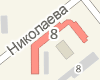 |
Institute of Philology Nikolaeva st., 8, Novosibirsk, 630090, Russian Federation +7-383-330-15-18, ifl@philology.nsc.ru |
© Institute of Philology |