 |
|
||||||||||||
|
Institute of Philology of
the Siberian Branch of Russian Academy of Sciences |
|
||||||||||||
|
|||||||||||||


 | |
| Sibirskii Filologicheskii Zhurnal (Siberian Journal of Philology) | |
| |
|
Article
Authors: Olga D. Zhuravel Novosibirsk State University, Novosibirsk, Russian Federation In the section Study of literature
Abstract: This article examines the reception within the Old Believer literary tradition of Maximus the Greek’s “Slovo o nestroyeniyakh i beschiniyakh” (“Word on Disorders and Outrages”), a work centered on the allegorical plot of a traveler’s encounter with a mysterious woman. This text served as a primary source for the prominent Old Believer writer Andrei Denisov in his sermon, “Slovo plachevno o zlostradaniyakh i skorbekh Tserkvi Khristovoy” (“Lamenting Word on the Sufferings and Sorrows of the Church of Christ”) (1720). The study identifies the stylistic, structural, and conceptual parallels and divergences between these two works. While the woman in Maximus the Greek’s work symbolizes the divine charisma of power, in Denisov’s adaptation, she represents the Old Believer Church. In both texts, the women’s lamentations serve an accusatory function, and the travelers are allusively linked to biblical prophets. conceptually, both authors ground their narratives in the idea of the “last accursed century” (“posledniy okayannyy vek”). Furthermore, the study traces the eschatological themes from the canzonas of Savonarola, which inspired Maximus the Greek, to the explicit apocalyptic imagery of the Revelation of St. John the Theologian found in Denisov’s work. Finally, the article introduces into scholarly circulation Ivan Filippov’s “Slovo o nastavnikakh Vygovskoy pustyni” (“A Word about the Teachers of the Vygovskaya Hermitage”), which further developed this eschatological interpretation of the plot. Keywords: Maximus the Greek, Andrei Denisov, Old Believers, manuscript tradition, baroque, preaching, Ivan Filippov, eschatology Bibliography: Barsov E. Andrey Denisov Vtorushin kak vygoretskiy propovednik: materialy dlya istorii raskola [Andrey Denisov Vtorushin as a Vygorets preacher: materials for the his-tory of the schism]. In Tr. Kievskoy dukhovnoy Akademii [Works of the Kyiv Theologi-cal Academy]. Kiev, 1867, vol. 4, pp. 81–95. Bubnov N. Yu. Staroobryadcheskaya kniga v Rossii vo vtoroy polovine 17 v. Isto-chniki, tipy i evolyutsiya [Old Believer book in Russia in the second half of the 17th century. Sources, types, and evolution]. St. Petersburg, Library of the Russian Academy of Sciences, 1995, 435 p. Crummey R. O. The Old Believers and the world of antichrist. The Vyg Community and the Russian State 1694–1855. Madison, Milwaukee and London, 1970, 258 p. Druzhinin V. G. Pisaniya russkikh staroobryadtsev: Perechen’ spiskov, sostavlennyy po pechatnym opisaniyam rukopisey [Writings of Russian Old Believers: List of copies compiled from printed descriptions of manuscripts]. St. Petersburg, Imp. arkheograficheskaya komissiya, 1912, 534 p. Filippov I. Istoriya Vygovskoy staroobryadcheskoy pustyni [History of the Vygovskaya Old Believer Hermitage]. St. Petersburg, Izd. D. E. Kozhanchikova, 1862, 480 p. Gardzaniti M. “Slovo o nestroeniyakh i bezchiniyakh Maksima Greka”: k istochnikam Placha Vasilii [The discourse on instability and chaos by Maxim the Greek. At the sources of Vasilija’s lamentation]. Russkaya Literatura. 2021, no. 1, pp. 55–70. Ivanov A. I. Maksim Grek i Savonarola [Maxim the Greek and Savonarola]. In Trudy Otdela drevnerusskoy literatury [Works of the Department of Old Russian Liter-ature]. Leningrad, Nauka, 1968, vol. 23, pp. 117–226. Kalugin V. V. Andrey Kurbskiy i Ivan Groznyy (Teoreticheskie vzglyady i literaturnaya tekhnika drevnerusskogo pisatelya) [Andrey Kurbsky and Ivan the Terrible. The-oretical views and literary technique of the ancient Russian writer]. Moscow, LRC Pub-lishing House, 1908, 416 p. Picchio R. Istoriya drevnerusskoy literatury [History of Old Russian Literature]. Moscow, Krug, 2002, 352 p. Prepodobnyy Maksim Grek. Sochineniya [St. Maximus the Greek. Works]. Moscow, Indrik, 2008, vol. 1, 568 p. Prepodobnyy Maksim Grek. Sochineniya [St. Maximus the Greek. Works]. N. V. Sinitsyna (Ed.). Moscow, Rukopisnye pamyatniki Drevney Rusi, 2014, vol. 2, 432 p. Sinitsyna N. V. Maksim Grek v Rossii [Maxim the Greek in Russia]. Moscow, Nau-ka, 1977, 332 p. Sinitsyna N. V. Tretiy Rim. Istoki i evolyutsiya srednevekovoy kontseptsii [Third Rome. Origins and evolution of the medieval concept]. Moscow, Indrik, 1998, 416 p. Shashkov A. T. Maksim Grek i ideologicheskaya bor’ba v Rossii vo vtoroy polovine 17 – nachale 18 v. (Poddelka i yeye razoblacheniye) [Maximus the Greek and the ideo-logical struggle in Russia in the second half of the 17th – early 18th centuries (Forgery and its exposure)]. In Trudy Otdela drevnerusskoy literatury [Works of the Department of Old Russian Literature]. Leningrad, Nauka, 1979, vol. 33, pp. 80–87. Shashkov A. T. Maksim Grek v staroobryadcheskoy rukopisnoy traditsii 18 veka Urala, Pomor’ya i Sibiri [Maximus the Greek in the Old Believer manuscript tradition of the 18th century in the Urals, Pomorie and Siberia]. In Iz istorii dukhovnoy kul’tury dorevolyutsionnogo Urala [From the history of spiritual culture of the pre-revolutionary Urals]. Sverdlovsk, UrSU, 1979, pp. 28–39. Shashkov A. T. Pomorskiy kodeks sochineniy Maksima Greka [The Pomor Codex of the Writings of Maximus the Greek]. In Istochnikovedenie i arkheografiya Sibiri [Source studies and archeography of Siberia]. Novosibirsk, Nayka, 1977, pp. 93–123. Viskovatyy K. K voprosu o literaturnom vliyanii Savonaroly na Maksima Greka [On the question of Savonarola’s literary influence on Maximus the Greek]. Slavia. 1939, vol. 17, no. 1–2, pp. 128–133. Zhuravel’ O. D. K istorii obraza tserkvi v staroobryadcheskoy literature: “Slovo pla-chevno o zlostradaniikh i skorbekh Tserkve Khristovy” Andreya Denisova [On the his-tory of the image of the church in Old Believer literature: “A lamentable word about the sufferings and sorrows of the Church of Christ” by Andrei Denisov]. In Obshchestvennoe soznanie naseleniya Rossii po otechestvennym narrativnym istochnikam 16–20 vv. [Public consciousness of the population of Russia according to domestic narra-tive sources of the 16th–20th centuries]. Novosibirsk, SB RAS, 2006, pp. 199–218. Zhuravel’ O. D. Literaturnoe tvorchestvo staroobryadtsev 18 – nachala 21 v.: temy, problemy, poetika [Literary creativity of the Old Believers 18th – early 21st centuries: themes, problems, poetics]. Novosibirsk, SB RAS, 2012, 442 p. Zhuravel’ O. D. Messianstvo v ideologicheskikh postroeniyakh staroobryadtsev [Messianism in the ideological constructs of the Old Believers]. Studia Slavica et Bal-canica Petropolitana. 2023, no. 2, (34). July–December. pp. 53–66. Zhurova L. I. Avtorskiy tekst Maksima Greka: rukopisnaya i literaturnaya traditsii: V 2 ch. [The author’s text by Maximus the Greek: manuscript and literary traditions]. Novosibirsk, 2008, SB RAS, pt. 1, 494 p.; 2011, pt. 2: Sochineniya [Works], 302 p. |


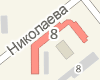 |
Institute of Philology Nikolaeva st., 8, Novosibirsk, 630090, Russian Federation +7-383-330-15-18, ifl@philology.nsc.ru |
© Institute of Philology |