 |
|
||||||||||||
|
Institute of Philology of
the Siberian Branch of Russian Academy of Sciences |
|
||||||||||||
|
|||||||||||||


 | |
| Sibirskii Filologicheskii Zhurnal (Siberian Journal of Philology) | |
| |
|
Article
Authors: Liudmila S. Dampilova, Ekaterina V. Sundueva Institute for Mongolian, Buddhist and Tibetan Studies of the Siberian Branch of the Russian Academy of Sciences, Ulan-Ude, Russian Federation In the section Study of folklore
Abstract: This study identifies the preservation of archaic mythological representations of the soul within contemporary Mongolian traditions. This study represents a pioneering effort in distinguishing the varied interpretations and roles attributed to the concept of the soul, referred to as sülde and sünesün in Mongolian, and rendered in Russian as “dusha” (“soul”). The analysis reveals that these are not identical concepts: they perform different roles within folklore texts and ritual practices. The soul sülde is a stable substance that enters the human body as an embryo, functioning as a vital force that only departs upon death or forced substitution. In contrast, the sünesün – the human doppelganger – is characterized by its mobility. A conceptual link between the sünesün (soul) and “spirit” is established: if the sünesün fails to return to the body for an extended period, it can transform into a negative demonological being. Consideration is also given to the role of sünesün as a wandering substance in the rite of soul recovery and the role of sülde as the primary life force in the rite of soul substitution. Furthermore, it should be noted that the nuances of these terms depend on narrative context, ritual action, and regional interpretations. While some narratives clearly distinguish between the two souls, others rely on a more intuitive differentiation between these ontological concepts. Keywords: mythology, folklore, rite, soul, life force, doppelganger, soul return, soul substitution Bibliography: Anokhin A. V. Dusha i ee svoystva po predstavleniyu teleutov [The soul and its properties according to the Teleutes]. In Sb. Muzeya antropologii i etnografii [Collection of the Museum of Anthropology and Ethnography]. Leningrad, AN SSSR, 1929, vol. 8. pp. 253–269. Batoeva D. B., Galdanova G. R., Nikolaeva D. A., Skrynnikova T. D. Obryady v traditsionnoy kul’ture buryat [Rituals in the traditional culture of the Buryats]. Moscow, Vost. lit., 2002, 222 p. Galdanova G. R. Dolamaistskie verovaniya buryat [Dolamaist beliefs of the Buryats]. Novosibirsk, Nauka, 1987, 113 p. Khangalov M. N. Sobr. soch.: V 3 t. [Сollected works: in 3 vols]. Ulan-Ude, Respublikanskaya tip., 2004, vol. 1, 508 p.; vol. 2, 312 p. Manzhigeev I. A. Buryatskie shamanisticheskie i doshamanisticheskie terminy: opyt ateisticheskoy interpretatsii [Buryat shamanistic and preshamanistic terms: an atheistic interpretation]. Moscow, Nauka, 1978, 128 p. Mikhaylov V. A. Religioznaya mifologiya [Religious mythology]. Ulan-Ude, Soel kul’tura, 1996, 111 p. Natsov G.-D. Materialy po istorii i kul’ture buryat [Materials on the history and culture of the Buryats]. Ulan-Ude, BCS SB RAS, 1995, pt. 1, 155 p. Neklyudov S. Yu. Dusha ubiennaya i mstyashchaya [An offended and vengeful soul]. Uchen. zap. Tartuskogo gos. un-ta. 1975, no. 394, pp. 65–75. (Trudy po znakovym sistemam [Works on sign systems], VII). Neklyudov S. Yu. Mongol’skikh narodov mifologiya [The Mongol peoples’ mythology]. In Mify narodov mira [Myths of the peoples of the world]. Moscow, Sov. entsikl., 1994, vol. 2, pp. 170–174. Seroshevskiy V. L. Yakuty. Opyt etnograficheskogo issledovaniya [The Yakuts. The experience of ethnographic research]. 2nd ed. Moscow, 1993, 736 p. Sundueva E. V. Svyaz’ dukha i dykhaniya v mongol’skikh yazykakh [The connection between spirit and breath in the Mongolian languages]. In Mir Tsentral’noy Azii: sb. nauch. st. [The world of Central Asia: coll. of sci. art.]. Irkutsk, Ottisk, 2017, pp. 400–403. Sundueva E. V. Vnutrennyaya forma leksemy sedkil “dusha” v mongol’skikh yazykakh [The inner form of the lexeme sedkil “soul” in the Mongolian language]. Vestnik NSU. Series: Linguistics and Intercultural Communication. 2018, vol. 16, no. 2, pp. 83–89. Tүdev L. Mongol zөgnөl [Mongolian foresight]. Ulaanbaatar, “Urlakh erdem” khevleliyn gazar khevlev, 2007, 276 p. |


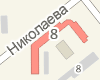 |
Institute of Philology Nikolaeva st., 8, Novosibirsk, 630090, Russian Federation +7-383-330-15-18, ifl@philology.nsc.ru |
© Institute of Philology |