 |
|
||||||||||||
|
Institute of Philology of
the Siberian Branch of Russian Academy of Sciences |
|
||||||||||||
|
|||||||||||||


 | |
DOI: 10.25205/2410-7883 Roskomnadzor certificate number Эл № ФС 77-84792 | |
| Syuzhetologiya i Syuzhetografiya | |
| |
|
Article
Authors: Svetlana Yu. Kornienko Novosibirsk State Pedagogical University, Novosibirsk, Russian Federation In the section Literary Life of the Plot
Abstract: This article examines the theme of impostors in Tsvetaeva’s 1916 poetry, in which the phenomenon of imposture acquires a metapoetic dimension. In Tsvetaeva’s work the images of famous rebels, Dmitry the Pretender (the False Dmitry) and Marina Mnishek get the key features of the modernist artist, such as transgression and the capacity for endless poetic rein-carnation in new “bodies” (texts). Tsvetaeva’s use of the impostor plot highlights the crucial connection between name and essence, soul and body. The poem «По дорогам, от мороза звонким…» (“Po dorogam, ot moroza zvonkim”, Along Roads, Ringing with Frost...) (1916) features an infernal wanderer, walking with a ‘silver child’ and having lost everything (both name and life), yet retaining her essence – the ability to be reborn. This article explores the sources of Tsvetaeva’s imagery, connecting it to Andrei Bely’s novel The Silver Dove and the historical works of D. I. Ilovaisky and D. V. Tsvetaev. Drawing on the mystical image of the ‘dove’s child’ from Bely’s novel and the historians’ emphasis on ‘Marinka’s son’, Tsvtaeva creates her unique interpretation of the plot. The article also considers Tsvetaeva’s influence on her contemporaries, such as S. Parnok and M. Voloshin, who incorporated her biographical and poetic features into their impostor figures. Unlike traditional interpretations that focus on black magic and reincarnation, Tsvetaeva uniquely emphasizes motherhood, linked not only to the gender privileges of the female poet but also to the motherhood of the poet herself, her own experience of pregnancy at the time of writing and her imaginary son. Therefore, the image of the ‘royal silver child’ in Tsvetaeva’s 1916 lyric can also be read in a specific biographical context, as a reference to the images of her own children: four-year-old Ariadna and the unborn infant. Keywords: the plot of impostors, the poetry of Marina Tsvetaeva, the poetry of Maximilian Voloshin, metaphors of creativity Bibliography: Meykin M. Marina Tsvetaeva: poetika usvoeniya [Marina Tsvetaeva: The Poetics of Assimilation]. Mosсow, Dom-muzei Mariny Tsvetaevoi Publ., 1997, 312 p. (in Russ.) Shevelenko I. D. Literaturnyi put’ Tsvetaevoi: Ideologiya – poetika – identichnost’ avtora v kontekste epokhi [Tsvetaeva’s Literary Road: Ideology, Poetics, and Identity of the Author in the Context of the Era]. Moscow, Novoe literaturnoe obozrenie Publ., 2002, 464 p. (in Russ.) |

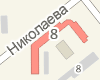 |
Institute of Philology Nikolaeva st., 8, Novosibirsk, 630090, Russian Federation +7-383-330-15-18, ifl@philology.nsc.ru |
© Institute of Philology |