 |
|
||||||||||||
|
Institute of Philology of
the Siberian Branch of Russian Academy of Sciences |
|
||||||||||||
|
|||||||||||||


 | |
DOI: 10.25205/2410-7883 Roskomnadzor certificate number Эл № ФС 77-84792 | |
| Syuzhetologiya i Syuzhetografiya | |
| |
|
Article
Authors: Ksenia V. Abramova Institute of Philology of the Siberian Branch of the Russian Academy of Sciences, Novosibirsk, Russian Federation In the section Literary Life of the Plot
Abstract: This article analyzes Yuri Yurkun’s novel “Swedish Gloves”, focusing on the narrative traits that reveal the protagonist’s coming-of-age, his transition from childhood to adolescence. The study explores the duality of the protagonist’s image, his androgyny, and mythological associations connected with his name. The protagonist’s image is fluid and shifting. It is constantly being supplemented with new details, but on the other hand, he seems to hide behind various masks. Furthermore, we also study the duality of the secondary characters and their shifting roles in Joseph’s life. We consider Yurkun’s description of the material world and the use of defamiliarization (‘enstrangerment’ device) in the text. This analysis clarifies the meaning of the title, the role of detail in creating the artistic world of this work, and identifies the characteristic features of stories about childhood and adolescence, as well as their manifestations in Yuri Yurkun’s text. These themes, motifs, and narrative features convey the protagonist’s perception of events, places, and objects, reflecting a child’s worldview. Finally, we demonstrate that events and objects in Yurkun’s text are often presented from two perspectives: that of the protagonist as a direct participant, and that of an external observer. The multi-faceted perspective suggests that “Swedish Gloves” exhibits traits indicative of a lyrical plot as a distinctive feature of a childhood story. This creates the impression of a personal diary. In this diary-like structure, lyrical elements, rather than a unified plot, describe the protagonist’s maturation, making this process the “moving and multidirectional super-event” of a childhood story told through a lyrical plot. Keywords: coming-of-age story, childhood theme, Yuri Yurkun, lyrical plot, Mikhail Kuzmin, defamiliarization, duality, thing Bibliography: Bogomolov N., Malmstad J. Mikhail Kuzmin: Iskusstvo, zhizn’, epokha [Mikhail Kuzmin: Art, Life, Era]. St. Petersburg, Vita Nova, 2007, 560 p. (in Russ.) Chudakov A. Slovo – veshch’ – mir. Ot Pushkina do Tolstogo [Word – thing – world. From Pushkin to Tolstoy]. Moscow, Sovremennyi pisatel’, 1992, 320 p. (in Russ.) Chumakov Yu. N. V storonu liricheskogo syuzheta [Towards the Lyrical Plot]. Moscow, YaSK Publ., 2019, 120 p. (in Russ.) Degen Yu. E. Poema o sontse [Poem about the Sun]. Petrograd [Tiflis], 1918, 24 p. (in Russ.) Haard E. de. Proza Yurkuna mezhdu neosentimentalizmom i emotsionalizmom (literaturnye otnosheniya s M. Kuzminym) [Yurkun’s Prose between Neosentimentalism and Emotionalism (Literary Relations with M. Kuzmin)]. Russian Literature, 2000, vol. 46, no. 4, pp. 411–435. (in Russ.) Kuzmin M. A. Uslovnosti [Conventions]. Moscow, RIPOL klassik, 2018, 306 p. (in Russ.) Kuzmin M. Nezdeshnie vechera: Stikhi 1914–1920 [Otherworldly Evenings: Poems 1914–1920]. Petrograd, Petropolis, 1921, 134 p. (in Russ.) Markov V. F. O svobode v poezii: Stat’i, esse, raznoe [On freedom in poetry: Articles, essays, miscellaneous]. St. Petersburg, Chernyshev Publ., 1994, 368 p. (in Russ.) Maurizio M. “Bespredmetnaya yunost’” A. Egunova: tekst i kontekst [A. Egunov’s “Abjectless Youth”: text and context]. Moscow, Kulagina Publ., Intrada, 2008, 254 p. (in Russ.) Nikolskaya T. L. Tvorcheskii put’ Yu. Yurkuna [The creative path of Yu. Yurkun]. In: Mikhail Kuzmin i russkaya kul’tura XX veka: tezisy i materialy konferentsii 15–17 maya 1990 [Mikhail Kuzmin and Russian Culture of the 20th Century: Theses and Materials of the Conference, May 15–17, 1990]. Leningrad, Muzei Anny Akhmatovoi v Fontannom Dome, 1990, pp. 101–102. (in Russ.) Shatalov A. Predmet vlyublennykh mezhdometii. Yu. Yurkun i M. Kuzmin – k istorii literaturnykh otnoshenii [The subject of amorous interjections. Yu. Yurkun and M. Kuzmin – on the history of literary relations]. Voprosy literatury [Questions of Literature], 1996, no. 6, pp. 58–109. (in Russ.) Tabunkina I. A. Syuzhet “tualet Venery”: ot O. Berdsli k Yu. Yurkunu [The “Venus’s Toilet” Plot: From O. Beardsley to Yu. Yurkun]. Mirovaya literatura v kontekste kul’tury [World Literature in the Context of Culture], 2014, no. 3 (9), pp. 103–113. (in Russ.) Toporov V. N. Veshch’ v antropologicheskoi perspektive (Apologiya Plyushkina) [The Thing in Anthropological Perspective (Plyushkin’s Apology)]. In: Toporov V. N. Mif. Ritual. Simvol. Obraz. Issledovaniya v oblasti mifopoeticheskogo: Izbrannoe [Myth. Ritual. Symbol. Image. Research in the Field of Mythopoeia: Selected Works]. Moscow, Progress – Kul’tura, 1995, pp. 7–111. (in Russ.) Yurkun Yu. A Novel, Novel, Short Stories]. St. Petersburg, Terra-Azbuka, 1995, 509 p. (in Russ.) |

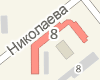 |
Institute of Philology Nikolaeva st., 8, Novosibirsk, 630090, Russian Federation +7-383-330-15-18, ifl@philology.nsc.ru |
© Institute of Philology |