 |
|
||||||||||||
|
Institute of Philology of
the Siberian Branch of Russian Academy of Sciences |
|
||||||||||||
|
|||||||||||||


 | |
DOI: 10.25205/2410-7883 Roskomnadzor certificate number Эл № ФС 77-84792 | |
| Syuzhetologiya i Syuzhetografiya | |
| |
|
Article
Authors: Ilya V. Kuznetsov Novosibirsk State Theater Institute, Novosibirsk, Russian Federation In the section Literary Life of the Plot
Abstract: The first work in the normative literature of Russian classicism, genre-wise designated as a “drama”, was the play by A. P. Sumarokov “The Hermit”. It was written and staged in 1757, when the drama genre was just beginning to form as an independent genre in the European literary system. According to researchers (P. N. Berkov, M. Levitt), the term “drama”, borrowed by Sumarokov, initially referred to Baroque spiritual performances. This idea is confirmed by the religious theme of the play, which is not typical of classical literature. The plot of “The Hermit” is based on the departure of the central character Eumenius from the world to the hermitage. Friends and family at first try to hinder Eumenius, but then, at his prayer, they change their position and accept the hermit's choice. Such a plot sequence reproduces a characteristic cluster of typical hagiographic motifs. These are such motifs as the hero's leaving home and his relatives’ attempts to stop him. They are accompanied by a final motif of the relative’s conversion to monasticism, infused by the main character. In “The Hermit”, it happens to the hero’s wife Parthenia. Moreover, Parthenia, trying to keep her husband from leaving, demonstrates a willingness to commit suicide. The two motifs, an attempted suicide and conversion to monasticism, point to the prototype of the Sumarokov play. It is not a hagiography in general, but a specific text – the Life of Theodosius Pechersky. It was created by Nestor as a paradigmatic text for the further hagiography in the 11th century. It concentrated the maximum number of typical Eastern hagiographic motifs and was to become a model for subsequent Russian lives of the reverend. The combination of these motifs allows us to see the Life of Theodosius of the Caves as a hagiographic model for the drama “The Hermit”. Sumarokov’s use of the hagiographic source is explained by the historical way of Russian literature. Having borrowed a new literary system in the 18th century, Russian literature modified it to express the figurative and semantic potential formed by the medieval tradition. Keywords: A. P. Sumarokov, “The Hermit”, drama, school drama, The Life of Feodosiy Pechersky, motive composition Bibliography: Abramovich D. I. K voprosu ob istochnikakh Nestorova zhitiya Feodosiya Pecherskogo. Izvestiya Otdela russkogo yazyka i slovesnosti [News of the Department of Russian Language and Literature], 1898, vol. 3, book 1, pp. 243–246. (in Russ.) Aristotel’. Ritorika. Poetika [Rhetoric. Poetics]. Moscow, 2005, 256 p. (in Russ.) Berkov P. N. A. P. Sumarokov (1717–1777) [A. P. Sumarokov (1717–1777)]. Moscow, Leningrad, 1949, 100 p. (in Russ.) Berkov P. N. Primechaniya [Notes]. In: Sumarokov A. P. Izbrannye proizvedeniya [Selected works]. Moscow, 1957, pp. 513–577. (in Russ.) Berkov P. N. Zhiznennyi i literaturnyi put' A. P. Sumarokova [The Life and Literary Path of A. P. Sumarokov]. In: Sumarokov A. P. Izbrannye proizvedeniya [Selected works]. Moscow, 1957, pp. 5–46. (in Russ.) Didro D. Estetika i literaturnaya kritika [Aesthetics and literary criticism]. Moscow, 1980, 659 p. (in Russ.) Fedotov G. P. Izbrannye trudy [Selected Works]. Moscow, 2010, 768 p. (in Russ.) Gitelman L. I. Motivy tragedii P. Kornelya v tvorchestve A. P. Sumarokova [Motifs of P. Corneille’s Tragedies in the Works of A. P. Sumarokov]. In: Sumarokovskie chteniya [Sumarokov readings]. St. Petersburg, 1993, pp. 51–55. (in Russ.) Grinberg M. S., Uspensky B. A. Literaturnaya voina Trediakovskogo i Sumarokova v 1740-kh – nachale 1750-kh godov [The Literary War between Trediakovsky and Sumarokov in the 1740s and early 1750s]. Moscow, 2001, 144 p. (in Russ.) Iyulskaya E. G. “K tebe, o Bozhe moi, ya nyne vopiyu” (tsikl molitvoslovii A. P. Sumarokova) [“To Thee, O my God, I now cry out” (A. P. Sumarokov’s cycle of prayers)]. In: Tvorchestvo A. P. Sumarokova v kontekste mirovoi literatury [A. P. Sumarokov’s creative work in the context of world literature]. Moscow, 2009, pp. 164–169. (in Russ.) Karavashkin A. V. Literaturnyi obychai Drevnei Rusi [The literary custom of Ancient Russia]. Moscow. 2011, 544 p. (in Russ.) Konyavskaya E. L. Avtorskoe samosoznanie drevnerusskogo knizhnika (XI – seredina XV v.) [The author’s self-awareness of the Ancient Russian scribe (11th – mid 15th century)]. Moscow, 2000, 199 p. (in Russ.) Kuskov V. V. Estetika ideal’noi zhizni. Izbrannye trudy [The aesthetics of an ideal life. Selected works]. Moscow, 2000, 320 p. (in Russ.) Kuznetsov I. V. “Gordyi chelovek” i mirnye tuzemtsy: poema “Tsygany” – pushkinskii anons XIX veka [“The Proud Man” and the Peaceful Natives: Pushkin’s 19th Century Poem “The Gypsies”]. SibSkript [SibScript], 2025, vol. 27, no. 1, pp. 119–127. (in Russ.) Kuznetsov I. V. Istoricheskaya ritorika: Strategii russkoi slovesnosti [Historical rhetoric: Strategies of Russian literature]. Moscow, 2007, 320 p. (in Russ.) Kuznetsov I. V. Teoreticheskaya istoriya, dialektika i ritorika russkoi slovesnosti [Theoretical History, Dialectics, and Rhetoric of Russian Literature]. Voprosy literatury [Literature Questions], 2011, no. 3, pp. 181–224. (in Russ.) Levitt M. Drama Sumarokova “Pustynnik”. K voprosu o zhanrovykh i ideynykh istochnikakh russkogo klassitsizma [Sumarokov’s Drama “The Hermit”. On the Genre and Ideological Sources of Russian Classicism]. In: XVIII vek [18th century]. St. Petersburg, 1993, iss. 18, pp. 59–74. (in Russ.) Pashkurov A. N. Natsional’nyi mif Rossii v drame A. P. Sumarokova “Pustynnik” [The National Myth of Russia in A. P. Sumarokov’s Drama “The Hermit”]. Vestnik Ryazanskogo gosudarstvennogo universiteta [Bulletin of the Ryazan State University], 2017, iss. 3 (56), pp. 67–73. (in Russ.) Ranchin A. M. Vertograd Zlatoslovnyi: Drevnerusskaya knizhnost’ v interpretatsiyakh, razborakh i kommentariyakh [Zlatoslovny Vertograd: Ancient Russian Book-ishness in interpretations, analyses and comments]. Moscow, 2007, 576 p. (in Russ.) Serman I. Z. Russkii klassitsizm: Poeziya. Drama. Satira [Russian Classicism: Poetry. Drama. Satire]. Leningrad, 1973, 284 p. (in Russ.) Shakhmatov A. A. Neskol’ko slov o Nestorovom Zhitii Feodosiya [A few words about Nestor’s Life of Theodosius]. In: Shakhmatov A. A. Istoriya russkogo letopisaniya [The history of Russian chronicling]. St. Petersburg, 2003, vol. 1, book 2, pp. 19–30. (in Russ.) Solovyev A. Yu. O konflikte v tragedii Sumarokova “Dimitriy Samozvanets” [On the conflict in Sumarokov’s tragedy “Dimitry the Pretender”]. In: XVIII vek [18th century]. St. Petersburg, 2020, iss. 30, pp. 83–101. (in Russ.) Sumarokov A. P. Dramaticheskie sochineniya [Dramatic writings]. Leningrad, 1990, 479 p. (in Russ.) Sumarokov A. P. Polnoe sobranie vsekh sochinenii v stikhakh i proze [The complete collection of all works in poetry and prose]. Moscow, 1781, pt. 6, 391 p. (in Russ.) Vsevolodsky-Gerngross V. N. Russkii teatr ot istokov do serediny XVIII veka [The Russian theater from the origins to the middle of the 18th century]. Moscow, 1957, 262 p. (in Russ.) Yakushkina T. V. Petrarka v russkoi literature XVIII v. [Petrarch in Russian Literature of the 18th Century]. Vestnik Sankt-Peterburgskogo universiteta. Ser. 9 [Bulletin of St. Petersburg University. Series 9], 2005, iss. 1, pp. 25–34. (in Russ.) Zhitie Feodosiya Pecherskogo [The Life of Theodosius of the Caves]. In: Pamyatniki literatury Drevnei Rusi. Nachalo russkoi literatury. XI – nachalo XII veka [Monuments of literature of Ancient Russia. The beginning of Russian literature. 11th – early 12th century]. Moscow, 1978, pp. 305–391. (in Russ.) |

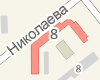 |
Institute of Philology Nikolaeva st., 8, Novosibirsk, 630090, Russian Federation +7-383-330-15-18, ifl@philology.nsc.ru |
© Institute of Philology |